A backpack sprayer turns a miserable afternoon of pumping a handheld jug into a steady walk across your whole yard, with weed killer, fertilizer, or pest control riding comfortably on your back. But the cheap ones can leave your arm aching before you finish, or run out of pressure right when the job gets big. We analyzed thousands of verified buyer reviews, recent sales data, and expert evaluations to find seven backpack sprayers that cover real ground without wearing you out.
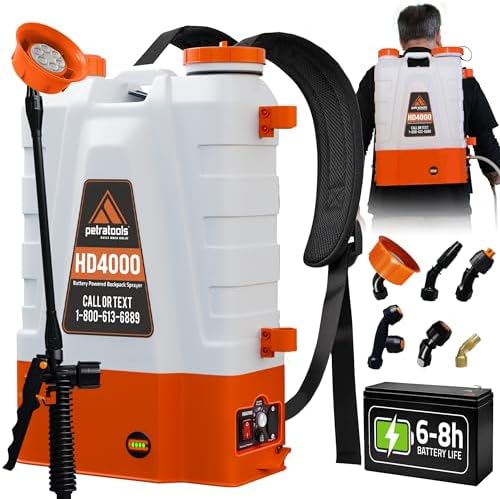
Our Best Overall pick: the most proven battery sprayer here, a 4-gallon unit whose 8Ah battery runs 6 to 8 hours (over 200 gallons) per charge, with double-padded straps and adjustable 40 to 90 PSI pressure.
The lowest sticker price in this lineup: a compact 2.6-gallon tank with a simple USB-rechargeable battery, three adjustable pressure levels and a 40-inch telescopic wand.
Our Best Value pick: a 4.2-gallon Makita 18V-compatible sprayer that includes its battery and charger, with up to 100 PSI, a digital voltage display, a low-voltage cutoff and a stainless-steel telescopic wand.
The proven no-charging pick: a professional-grade 4-gallon manual piston sprayer with Viton chemical-resistant seals, a 4-position pressure regulator and a reputation for lasting decades.
4.2-gal tank · up to 90 PSI · DeWalt 20V (tool only)
A 4.2-gallon backpack sprayer that runs off your own DeWalt 20V battery rather than a bundled pack, with a built-in mixing agitator and pressure adjustable up to 90 PSI. Six nozzles and a 3.5-foot hose cover everything from fine mist to a stronger stream for weeds and fertilizer.
A DeWalt 20V-compatible 4.2-gallon sprayer with one-touch auto-mixing and the lightest build here at about 7 pounds empty, sold as a bare tool without a battery or charger.
Short on time? These three cover most buyers: our top-graded 4-gallon pick with the longest battery runtime, our Best Budget Pick for everyday yard work, and the best-value 4-gallon Makita-compatible unit that includes its battery.
Backpack Sprayers 101: What They Do & How to Choose
Understand the category before you buy - what the science actually says, and which specs matter.
Every backpack sprayer holds liquid and pushes it through a wand, but how it builds pressure, how much it carries, and how it sits on your shoulders decide whether the job feels easy or endless. Here is how they work, the one choice that matters most, and the features actually worth comparing.
What does a backpack sprayer actually do?
A backpack sprayer is a tank you wear, connected to a hose, a wand, and a trigger. You fill the tank with your mix, build up pressure, and pull the trigger to send a controlled spray exactly where you point it. Because the weight rides on your back instead of one hand, you can treat a long fence line or a full lawn in one pass.
The tank holds your solution, ranging from about 3 gallons on the most compact models up to 5 gallons on the SEESII.
A pump builds the pressure that pushes liquid out.
The wand and nozzles shape the spray, from a fine mist to a focused stream.
Padded straps carry the load so your shoulders take it, not your arms.
The pump type is the real decision
Before tank size or nozzle count, look at how the sprayer builds pressure, because that single choice shapes the whole job.
A manual pump sprayer, like the SOLO 425 with its piston pump, never needs charging. You build pressure by working a lever, and you control that pressure yourself by how hard and how often you pump. That gives you full independence from a battery, but on a big yard your arm tires, because you are the engine keeping the spray alive.
A battery sprayer, which covers the other six models here including the PetraTools, SEESII, and SideKing models, holds a steady pressure and sprays continuously with no pumping at all. You squeeze the trigger and it keeps flowing, which is exactly what saves you on a large property where a manual pump would wear you down. The tradeoff is that you depend on a charge, though runtimes are generous: the PetraTools runs up to 6 hours and the SEESII's dual-battery system lets you swap in a fresh pack rather than stop to recharge.
The honest way to choose is to match the pump to the size of the job. For quick touch-ups and small gardens, a manual piston pump is simple and always ready. For a big lawn, acreage, or a long session, a battery model spares your arm and keeps the pressure even from the first spray to the last.
Which specs actually matter?
Once you have settled on a pump type, a few features decide which sprayer fits you:
Pump type: The core decision above. Manual for independence and small jobs, battery for steady pressure across large ground.
Tank capacity: This sets how far you go between refills, from 3 gallons up to the 5 gallon SEESII. Remember that a full tank of liquid is heavy, so more capacity means more weight on your back.
Straps and padding: Because that full tank is a real load, padded straps matter. Look for double-padded or felt-padded shoulder straps and a back pad, like the PetraTools airflow back pad or the SOLO shoulder-saver harness.
Pressure range: Adjustable pressure lets you go gentle for delicate plants or strong for tough spots. The SEESII and SideKing units here reach up to 100 PSI, while the manual SOLO tops out around 90 PSI.
Nozzles included: The right nozzles let you switch between a fine mist for weeds and a stream for spot treatment. Kits range from 4 nozzles on the SOLO up to 6 or 7 on the PetraTools and SEESII models.
Wand length: A longer wand reaches under shrubs and into corners without bending. Options run from the SOLO 21 to 28 inch wand up to the SideKing 4-gallon's 64 inch hose reach, with the PetraTools HD3000's 34.5 inch wand covering close-in work.
Empty weight: Lighter is easier to carry all day. Empty weights here run from about 9 pounds on the SideKing 4-gallon to about 15 pounds on the PetraTools, before you add any liquid.
How we grade products
Graded Picks rankings are aggregated from several independent signals: verified buyer ratings and the size of the review base for credibility, recent monthly purchase volume for relevance, assessments from trusted lawn and garden publications, and how each product places in leading category lineups. For backpack sprayers we weigh:
Pump type and pressure consistency
Tank capacity and refill range
Strap comfort and load balance
Nozzle selection and spray control
Wand reach and build quality
Battery runtime, where it applies
Overall value for the price
Safety note: Always wear protective gear when spraying, including gloves, eye protection, long sleeves, and a mask suited to your chemical. Rinse the tank, wand, and nozzles thoroughly with clean water after every use, especially after herbicides, so residue does not linger or damage the next job. Never mix incompatible products in the same tank, follow every label direction on your chemical, and store the sprayer empty and clean.
In-Depth Reviews
Everything we learned from buyer reviews and expert testing, product by product.
The PetraTools HD4000 is our Best Overall pick: the most proven battery sprayer on this page, pairing the longest real-world runtime here with the comfort features that matter when a full tank tops 30 pounds, though at $199.99 it costs roughly twice what the SEESII does. Its 8Ah battery is rated for 6 to 8 hours of spraying - a figure PetraTools and independent testers put at more than 200 gallons per charge - so most homeowners get through an entire property, or several, before recharging. LawnStarter named it a top value battery sprayer and OPE Reviews called it a capable, more affordable alternative to the pricier Milwaukee Switch Tank, both praising the steady pressure and easy operation. Adjustable pressure runs from 40 to 90 PSI, a 34.5-inch wand and six nozzles cover broadcast and spot work, and the double-padded shoulder straps with a cushioned, airflow back pad make the load genuinely bearable. A translucent tank with gallon markings lets you mix and monitor solution at a glance, and a locking trigger saves your hand on long jobs. The main caveats are its roughly 15-pound empty weight and a shorter standard warranty than some rivals unless you register it.
Tank capacity4 gallons
Pump typeBattery (12V 8Ah)
Max pressure (PSI)40-90 PSI adjustable
Wand & nozzles34.5-in wand, 6 nozzles
Strap / harnessDouble-padded shoulder straps + airflow back pad
Weight (empty)About 15 lbs
Warranty90-day + 90-day with registration
Pros
Our Best Overall pick: 6 to 8 hours (200+ gallons) of spraying per charge - the longest here
Praised by LawnStarter for value and by OPE Reviews for steady pressure
Adjustable 40 to 90 PSI with a 34.5-inch wand and six nozzles
Double-padded straps and airflow back pad ease a 30-pound load
Translucent tank with gallon markings and a locking trigger
Cons
Around 15 pounds empty, heavier than the lighter lithium units here
Standard warranty is short unless you register for the extension
Lead-acid battery is bulkier than the lithium packs on some rivals
Who is it for?
Our Best Overall pick for homeowners and part-time pros who want the longest runtime and the most comfortable carry for spraying a whole property in one go, and who value the deepest expert track record.
Who is it not for?
Anyone who wants the lightest possible empty weight or who sprays so rarely that a no-charging manual pump makes more sense instead of a battery unit.
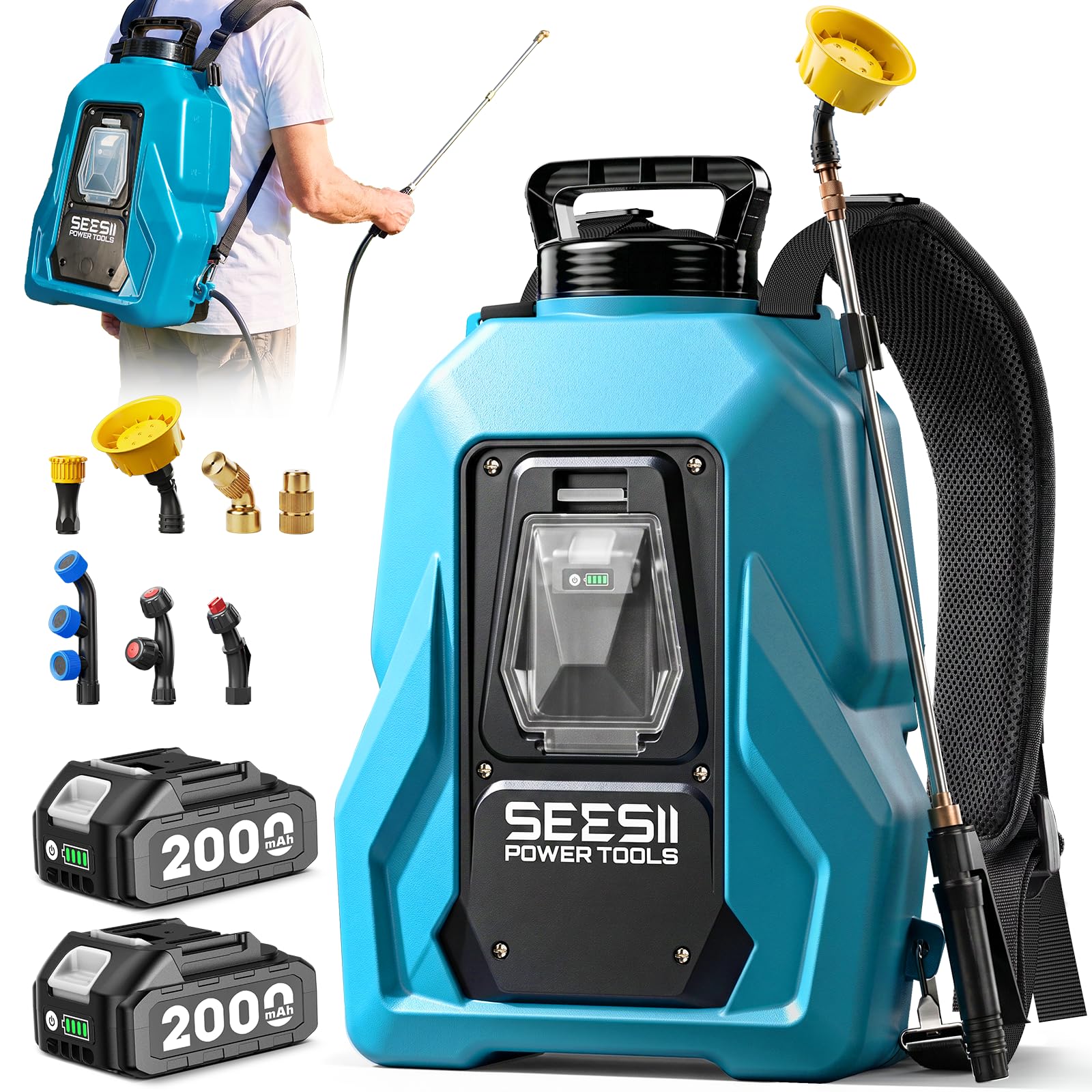
The SEESII combines the largest tank in this comparison with a two-battery system, and it is frequently sold at a deep discount. Its 5-gallon one-piece, blow-molded tank is engineered to be leak-proof, and because it ships with two 2.0Ah lithium batteries you can swap in a fresh pack and keep working: roughly 1 hour 48 minutes and about 66 gallons per battery, so nearly 130 gallons before both need charging. Pressure is adjustable from 0 to 100 PSI, and an upgraded retractable brass wand with seven interchangeable nozzles resists corrosion better than the plastic wands on cheaper units and reaches 20 to 26 feet. SEESII backs it with a 3-year warranty and lifetime technical support, unusually generous in this field. The trade-offs are real: a full 5-gallon tank is the heaviest load here at close to 40 pounds, the mesh straps are less plush than the PetraTools padding, and it has less independent testing behind it than the established names. Some buyers have also reported a leak on first use, so test it with plain water before the first spray day.
Tank capacity5 gallons (19 L)
Pump typeBattery (dual 2.0Ah lithium)
Max pressure (PSI)0-100 PSI adjustable
Wand & nozzlesTelescopic brass wand, 7 nozzles
Strap / harnessBreathable mesh shoulder straps
Weight (empty)About 13 lbs
Warranty3 years + lifetime tech support
Pros
Largest 5-gallon tank in this comparison
Two swappable lithium batteries for nearly 130 gallons before charging
Corrosion-resistant telescopic brass wand with seven nozzles
0 to 100 PSI adjustable pressure with 20 to 26 foot reach
Standout 3-year warranty plus lifetime technical support
Cons
A full 5-gallon tank is the heaviest load here at nearly 40 pounds
Mesh straps are less cushioned than the PetraTools padding
Less independent testing than the established brands in this lineup
Who is it for?
Buyers who want the biggest tank and a battery they can hot-swap to keep spraying, backed by a long warranty, at a price well below the premium units.
Who is it not for?
Anyone sensitive to carry weight or who wants the most heavily documented, expert-tested brand; the PetraTools has more coverage behind it.
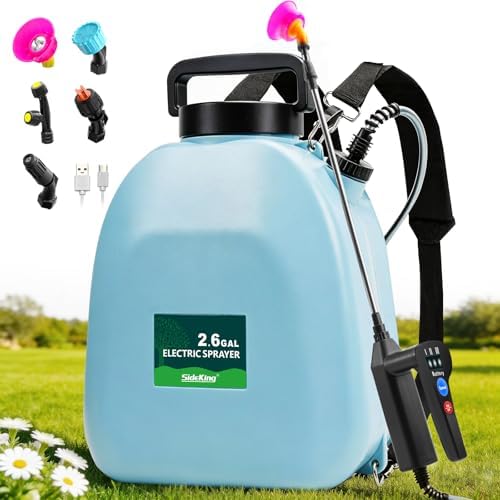
SideKing's smallest entry in this comparison trades the Makita battery compatibility of its 4.2-gallon sibling for a simpler approach: a built-in 7.4V, 4000mAh lithium battery you top up over USB, no separate tool-brand charger required. That pack is rated for roughly 2 to 3 hours of continuous spraying, and a three-level pressure selector (mist, medium and strong) cycles through five interchangeable nozzles - fan, cone, windproof, F-type dual and a 6-hole pattern - for everything from a fine mist on seedlings to a focused stream on tough weeds. A 40-inch telescopic wand, a battery-level indicator, an anti-kink coil hose and a measuring cup for mixing round out the kit, and at 2.64 gallons the tank is the smallest in this lineup, which keeps the whole unit light for smaller yards and spot treatments. Its 60 PSI ceiling is well below the 90-120 PSI reached by the full-size battery units elsewhere in this comparison, so it is built for precision and portability rather than acreage-scale jobs. SideKing backs it with the brand's standard 1-year warranty, and at well under half the price of most other sprayers here, it is the cheapest entry point for anyone who just needs a capable sprayer for a modest yard.
Tank capacity2.64 gallons
Pump typeBattery (7.4V, 4000mAh, USB rechargeable)
Max pressure (PSI)Up to 60 PSI, 3 adjustable levels
Wand & nozzles40-in telescopic wand, 5 nozzles
Strap / harnessAdjustable backpack strap
Runtime per chargeAbout 2-3 hours
Warranty1 year
Pros
The lowest price in this comparison by a wide margin, even before its Prime-exclusive discount
Simple USB-rechargeable battery needs no separate tool-brand charger
Three-level pressure selector and five nozzles cover mist through focused-stream patterns
40-inch telescopic wand, battery indicator and anti-kink hose in a light, compact kit
Includes a measuring cup for accurate mixing
Cons
Smallest tank in this lineup at 2.6 gallons - expect more refills on a bigger yard
60 PSI ceiling is the lowest pressure of any battery unit in this comparison
No major professional publication has tested this specific model yet
Who is it for?
Buyers with a small yard or garden who want SideKing's easiest, most affordable sprayer for everyday spot treatments and light weed control.
Who is it not for?
Anyone treating a large property who needs higher pressure or a bigger tank; the SideKing 4.2-gallon, the PetraTools and the SEESII cover that instead.
The SideKing 4.2-gallon earns Best Value by packing more capability into a near-budget price than anything else on this page: a Makita 18V-compatible build, a 2.6Ah battery and charger in the box, and pressure adjustable up to 100 PSI. A digital voltage display with automatic low-voltage cutoff protects the pack and shows exactly how much charge remains, a detail the lawn-care review site landscapetoolsreview.com called out as a genuine convenience. A stainless-steel telescopic wand, a 64-inch hose and five interchangeable nozzles (fan, cone, windproof, dual and stream) cover broadcast and spot spraying, and at about 9 pounds empty it is easy to carry. Buyers describe it as comfortable and efficient for weed control and general yard work. SideKing has less independent testing behind it than the flagship brands here, and the VAXMAY Best Budget Pick is a few cents cheaper with a very similar kit, so the case for this one rests on the slightly larger tank and the stainless wand.
Includes a 2.6Ah battery and charger on the widely owned Makita 18V platform
Digital voltage display with automatic low-voltage cutoff protects the battery
Stainless-steel telescopic wand with a 64-inch hose for extended reach
Five nozzles included: fan, cone, windproof, dual and stream
Up to 100 PSI and about 9 pounds empty at a near-budget price
Cons
Limited independent expert testing compared with established brands
Feature set closely overlaps the VAXMAY Best Budget Pick
Plastic tank construction rather than a more rugged blow-molded design
Who is it for?
Makita 18V owners and value hunters who want a well-equipped 4-gallon battery sprayer with battery and charger included, without paying premium-brand prices.
Who is it not for?
Buyers who want the longest-proven track record or the biggest tank (the PetraTools and SEESII lead there), or anyone who wants the absolute lowest price (the VAXMAY Best Budget Pick edges it).
The SOLO 425 is the only manual sprayer in this lineup, and it earns its place back on the list by doing something no battery unit can: it never needs charging and, by many long-term accounts, simply refuses to die. This is a manual piston-pump sprayer - you build pressure with a hand lever rather than a motor - and its high-performance piston reaches up to 90 PSI through a four-position regulator, enough for tree work and long-reach spraying. SOLO is a professional brand, and the 425 shows it: highly chemical-resistant Viton seals throughout let it handle aggressive concentrates, the UV-stabilized tank resists sun damage, and a stainless-steel wand and adjustable felt-padded shoulder-saver harness are built for full days of use. Expert retailers like DoMyOwn and Sprayer Depot stock it as a trade staple, and owner accounts of units still working after twenty-plus years are common. The trade-offs are inherent to manual sprayers: you have to keep pumping to hold pressure, the stroke tires your arm over a big yard, and the base warranty is short (the limited lifetime coverage applies mainly to the tank).
Tank capacity4 gallons
Pump typeManual piston pump
Max pressure (PSI)Up to 90 PSI (4-position regulator)
The AC16 pairs a 4.2-gallon tank with a battery-driven pump designed to run on any standard DeWalt 20V battery, so buyers who already own DeWalt tools can skip paying for another proprietary pack. A built-in mixing system keeps wettable powders and liquid concentrates agitated instead of settling at the bottom of the tank, a common complaint with simpler gravity sprayers. Pressure is adjustable up to about 90 PSI, and the kit ships with six nozzles plus a telescopic wand for reaching tall shrubs or upper tree branches. A padded shoulder strap and lumbar support board help distribute the load of a full tank across a long session. Because it is sold as a tool-only unit, buyers need a compatible DeWalt 20V battery and charger on hand before first use. The plastic housing and 3.5-foot hose keep the overall weight in line with other battery backpack sprayers in this class.
Tank capacity4.2 gallons
Power sourceBattery powered (DeWalt 20V, tool only)
Maximum pressureUp to 90 PSI
Hose length3.5 feet
Nozzles6 nozzles included
Strap / harnessPadded shoulder straps with lumbar support board
MaterialPlastic
Pros
Runs on any standard DeWalt 20V battery, handy for buyers who already own the tool line
Built-in mixing system keeps concentrate agitated instead of settling
Adjustable pressure up to 90 PSI with six nozzles and a telescopic wand
Padded straps and a lumbar support board ease the weight of a full tank
Listed at 29 percent off, among the steeper discounts in this lineup
Cons
Sold as tool-only, so a compatible DeWalt 20V battery and charger are a separate purchase
Plastic build and a 3.5-foot hose are shorter than some rivals offer
Less established track record than veteran sprayer brands like SOLO
Who is it for?
Shoppers who already own DeWalt 20V batteries and want a 4.2-gallon sprayer with pressure adjustment and a mixing agitator without paying for another battery pack.
Who is it not for?
Buyers without existing DeWalt batteries, who would need to budget for a battery and charger on top of the sprayer's price.
The Ecarke is the only sprayer on this page built around the DeWalt 20V battery platform, which makes it a natural fit for anyone who already owns those packs. Its standout feature is a one-touch auto-mixer that stirs powders, liquids and concentrates inside the tank, and owners single it out as a real time-saver. A 4.2-gallon tank, pressure adjustable from 0 to 100 PSI, a stainless-steel telescopic wand that extends to 42 inches and six interchangeable nozzles cover both broadcast and spot jobs, and at roughly 7 pounds empty it is the lightest unit here. The catch is that it is sold tool-only: you need your own DeWalt 20V battery and charger, so the sticker price understates the cost for buyers starting from scratch. It is a newer listing with no dedicated professional test coverage yet, and Ecarke backs it with a 12-month limited warranty, so it suits existing DeWalt owners better than first-time cordless buyers.
Tank capacity4.2 gallons
Pump typeBattery (DeWalt 20V compatible; battery not included)
The stars you see are the Graded Picks cumulative score, not a single retailer's average. It blends verified buyer reviews aggregated across major retailers, assessments from professional reviewers and expert testers, and how prominently the product features in leading category lineups.
Advertising Disclosure
Our rankings are compiled by aggregating several independent signals, including verified buyer feedback, how popular a product currently is with shoppers, and evaluations published by professional reviewers. Editorial opinions are our own.
Please note that we participate in affiliate marketing programs. When you purchase through links on our site, we may earn a commission. As an Amazon Associate we earn from qualifying purchases. This comes at no additional cost to you and helps support the resources required to provide valuable content.