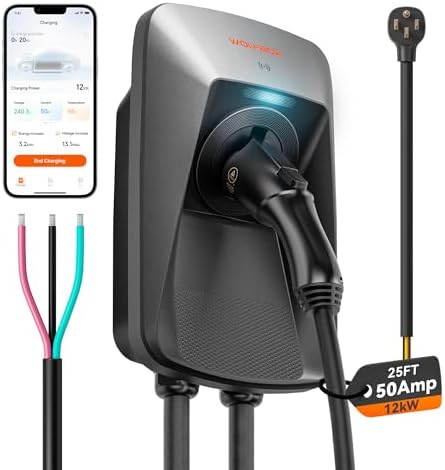
A home Level 2 charger turns your garage into your own filling station: plug in overnight, wake up to a full battery, and skip the public-station hunt entirely. But the biggest number on the box, the amperage, is also the one most likely to mislead you, because your house may not be able to feed it. We analyzed thousands of verified buyer reviews, recent sales data, and expert evaluations to find seven home EV chargers that deliver real overnight range without asking more of your panel than it can give.
Every product we compared, in ranked order. Tap through to Amazon to check today's price, or jump to the full review below.
1
EVIQO 48-Amp
Best Overall12% OFF
EVIQO 48-Amp Level 2 EV Charger (Hardwired)
5.0
48A / 11.5kW · J1772 · IP66, NEMA 4
Our Best Overall pick: a hardwired 48-amp/11.5kW unit built to IP66/NEMA 4 weatherproofing with a 25-foot cable and a straightforward smart app. Independent EVSE testing rated it a strong performer on power delivery and build quality.
EVIQO 40-Amp Level 2 EV Charger (NEMA 14-50 Plug-in)
4.9
40A / 9.6kW · J1772 · Plug-in NEMA 14-50
EVIQO's plug-in 40-amp/9.6kW charger for non-Tesla EVs comes in at the lowest price of any full 240V home charger in this comparison, built on the same platform independent EVSE testers rate among the strongest in its price class, with IP66/NEMA 4 weatherproofing and a 25-foot J1772 cable.
A hardwired Level 2 charger rated up to 50A and 12kW, adding up to 48 miles of range per hour, with WiFi and Bluetooth built into the Autel Charge app. Its flame-retardant internals and real-time temperature monitoring are engineered for a 10-year service life.
Up to 80A / 19.2kW · hardwired, 240V · 25-ft cable
Our Best for High-Power Charging pick: a hardwired Level 2 charger that scales up to 80A and 19.2kW, the highest output in this lineup, adding roughly 70 miles of range per hour. It pairs that power with OCPP 2.0.1 connectivity and dynamic load management for homes running multiple high-draw circuits.
A 40-amp, 9.6kW Level 2 home charger built specifically for Tesla's NACS connector, plugging into a standard NEMA 14-50 outlet. It pairs a 25-foot cable with WiFi app control and a NEMA 4 weatherproof enclosure rated for outdoor installs.
Our Best Value pick: the most capability per dollar here, with output switchable between 40, 48 and 50A by internal dip switches and the option to run hardwired or on the included NEMA 14-50 plug.
A Level 1 charger that plugs into any standard 120V household outlet, pulling 15A and 1.65kW without any electrical work. It is built for drivers whose daily mileage is modest enough that overnight trickle charging keeps up.
Short on time? These three cover most buyers: our top-graded hardwired choice, the best value for money with a selectable 50-amp output and flexible install, and the fastest charger for high-power installs.
Understand the category before you buy - what the science actually says, and which specs matter.
Every Level 2 charger promises fast charging, higher amperage, and more miles per hour, but the speed you can actually use depends less on the charger and more on your home wiring. Here is how these units work, the one question to answer before you compare amperage at all, and the specs that genuinely change your day-to-day experience.
What does a Level 2 EV charger actually do?
A Level 2 charger runs on a 240V circuit, the same kind of high-power line that feeds an electric dryer or oven, which is why it charges several times faster than a standard wall outlet. It does not store electricity. It safely manages the flow of power from your panel to your car and stops when the battery is full.
It connects to a 240V circuit, either hardwired into your panel or plugged into a large outlet like a NEMA 14-50.
It delivers power at a rated amperage, commonly 40, 48, or 50 amps here, up to 80 amps on the Autel MaxiCharger, so higher amperage adds more miles of range per hour.
Most connect to WiFi and a smart app so you can schedule charging for cheaper overnight hours.
The honest first question is your electrical panel, not the charger's top speed
Here is what the amperage number on the box does not tell you: a charger can only pull the amperage its circuit is allowed to supply, and by electrical code it needs a breaker rated about 25 percent higher than its continuous output. That gap changes everything.
A 48A charger like the EVIQO 48-Amp does not run on a 48A circuit. It requires a dedicated 60A circuit. A 50A-capable unit such as the WOLFBOX WE50 wants a 70A to 80A circuit, and the 80A Autel MaxiCharger needs a full 100A circuit of its own. Many home panels do not have that much spare capacity once the air conditioner, oven, and dryer are accounted for.
So the honest starting point is not "how fast can it go," it is "what can my panel actually feed." Happily, flexibility is built in. The Autel MaxiCharger 40-Amp is adjustable from 6A to 40A in the app, and the WOLFBOX WE50 lets you select 40A, 48A, or 50A, so you can dial the charger down to match a smaller circuit and still charge every night. For most drivers, a 40A charger on a 50A circuit already replaces a full day of driving overnight.
Once you know your circuit, two choices follow. Decide between a plug and a hardwire: a NEMA 14-50 plug, like the one on the EVIQO NACS unit, lets you unplug and take the charger with you if you move, while hardwiring, as on the Autel MaxiCharger, allows the highest power levels. Then match the connector to your car: J1772 for most non-Tesla EVs, and NACS for Tesla.
Which specs actually matter?
Once you know what your panel can supply, a few features decide which charger fits you:
Amperage and circuit requirement: The real speed lever, but only if your circuit supports it. Outputs here run from 40A up to 80A, and each needs a breaker sized roughly 25 percent higher, so confirm your panel before chasing the highest number.
Plug versus hardwired: A NEMA 14-50 plug lets you unplug and relocate the unit. Hardwiring is permanent and unlocks the top power levels, including the 48A and higher units here.
Connector type: Match it to your vehicle. J1772 covers most non-Tesla EVs, while NACS is the Tesla connector. Getting this wrong means it will not plug into your car.
Cable length: Every charger in this lineup runs a 25 ft cable, so reach comes down to where you mount or plug in the unit relative to your parking spot.
WiFi and app control: Every hardwired or plug-in charger here uses a smart app over WiFi for scheduling and session tracking. Some add Bluetooth or RFID card access, and the Autel MaxiCharger layers in AI cloud features.
Indoor and outdoor rating: If the unit lives outside, weatherproofing matters. Ratings here range from IP66/NEMA 4 on the EVIQO units to NEMA 4X on the Autel and WOLFBOX chargers.
How we grade products
Graded Picks rankings are aggregated from several independent signals: verified buyer ratings and the size of the review base for credibility, recent monthly purchase volume for relevance, assessments from trusted EV and home-electrification publications, and how each product places in leading category lineups. For home EV chargers we weigh:
Real usable charging speed for typical home circuits
Installation flexibility, plug versus hardwired
Connector fit for common vehicles
App reliability and scheduling features
Weatherproofing and build durability
Overall value for the price
Installation safety note: Before you buy for a target amperage, have a licensed electrician confirm your panel capacity and the dedicated circuit and breaker your chosen charger requires. A 240V charging circuit is a permanent electrical addition that must meet local code, and an electrician can tell you whether your panel has room for a 48A or higher unit or whether a lower setting is the safer choice.
In-Depth Reviews
Everything we learned from buyer reviews and expert testing, product by product.
EVIQO 48-Amp
Best Overall12% OFF
1. EVIQO 48-Amp Level 2 EV Charger (Hardwired)
5.0
The EVIQO 48-amp hardwired charger is our Best Overall pick this update on the strength of genuinely broad expert coverage and a feature set that punches above its price. In independent EVSE lab testing, the closely related Evipower Gen 2 hardwired model scored highest in power delivery and construction, and reviewers single out the redesigned cable holster and swivel connector as real usability upgrades over the first generation. It delivers 11.5kW (48A) through a 25-foot cable, is UL and ETL certified, and its IP66/NEMA 4 enclosure is rated for rain, snow, ice and temperatures from -22F to 122F. The WiFi smart app covers scheduling, cost tracking and charge history without a subscription. A 3-year warranty is standard, with a 4-year extension available.
Max output48A / 11.5kW
Connector typeJ1772 (non-Tesla)
Cable length25 ft
InstallationHardwired (dedicated 60A circuit)
ConnectivityWiFi (2.4GHz) + smart app
Weatherproof ratingIP66, NEMA 4
Warranty3 years (4-year upgrade available)
Pros
Independently tested as a top performer for power delivery and build quality among home EVSE chargers
IP66/NEMA 4 weatherproofing rated from -22F to 122F
Redesigned cable holster and swivel connector simplify wrap-up
UL and ETL certified with a straightforward, subscription-free smart app
3-year warranty, extendable to 4 years
Cons
Hardwired install requires a licensed electrician and a dedicated 60A circuit
Scheduling and load-management features are more basic than premium rivals
No NEMA 14-50 plug option on this hardwired version
Who is it for?
Homeowners who want a proven, well-built 48-amp charger and are already planning a professional hardwired install.
Who is it not for?
Renters or anyone who wants a plug-and-move charger - a NEMA 14-50 plug-in model fits that need better.
2. EVIQO 40-Amp Level 2 EV Charger (NEMA 14-50 Plug-in)
4.9
A strong plug-in Level 2 choice. The EVIQO 40-Amp NEMA 14-50 charger is the most affordable full-power charger in this lineup, on the strength of unusually broad and consistently positive expert coverage. EnergySage, EV Pulse, TorqueNews and EVchargingStations all reviewed this exact plug-in Gen 2 model, and EVchargingStations' independent ChargerRater test scored it among the strongest chargers it has tested for power delivery and build quality. It plugs into a standard NEMA 14-50 outlet rather than requiring a hardwired install, delivering up to 9.6kW (40A) through a 25-foot J1772 cable, and shares its hardwired sibling's IP66/NEMA 4 weatherproof enclosure rated from -22F to 122F. The WiFi smart app covers scheduling and consumption tracking without a subscription, and reviewers single out the rubberized cable holster and connector as sturdier than typical for the price. EVIQO backs it with a 3-year warranty.
Max output40A / 9.6kW
Connector typeJ1772 (non-Tesla)
Cable length25 ft
InstallationPlug-in, NEMA 14-50
ConnectivityWiFi (2.4GHz) + smart app
Weatherproof ratingIP66, NEMA 4
Warranty3 years
Pros
Reviewed positively across multiple independent EV-charging publications (EnergySage, EV Pulse, TorqueNews, EVchargingStations)
Scored among the top performers on EVchargingStations' independent ChargerRater test for power delivery and build quality
Plugs into an existing NEMA 14-50 outlet - no hardwiring required if one is already installed
IP66/NEMA 4 weatherproofing rated from -22F to 122F
Subscription-free WiFi app; 3-year warranty
Cons
Capped at 40A/9.6kW - the brand's hardwired 48A model charges faster
Still needs a NEMA 14-50 outlet on a properly rated circuit, which may require an electrician if none exists
J1772 connector only - not compatible with Tesla/NACS vehicles without an adapter
Who is it for?
Non-Tesla EV owners who already have (or can easily add) a NEMA 14-50 outlet and want our Best Value pick: the most affordable, most widely and positively reviewed plug-in charger in this lineup.
Who is it not for?
Tesla owners needing a NACS connector (see the EVIQO NACS model instead) or anyone chasing the fastest possible home charging speed.
This Autel charger delivers up to 12kW through a hardwired 240V connection, with current adjustable from 6A to 50A, adding as much as 48 miles of range per hour. It uses flame-retardant materials rated to 950°C alongside real-time temperature monitoring, which Autel says supports a 10-year lifespan for the unit. The Autel Charge app, reachable over WiFi or Bluetooth, handles scheduling, usage tracking, and charging optimized around off-peak electricity rates. The cable stays flexible down to -40°C, which matters for anyone mounting it outdoors in a cold climate. It is UL-certified through CSA and comes with a 5-year warranty and 24/7 expert support. Reviewers call the installation process straightforward and describe the charger as smart and reliable day to day.
ConnectorSAE J1772
Max outputUp to 50A, 12kW
Power inputHardwired, 240V
Cable length25 ft
ConnectivityWiFi and Bluetooth, Autel Charge app
Cold-weather ratingCable flexible to -40°C
Warranty5 years
Pros
Full 50A, 12kW output with no plug-in power cap
Flame-retardant build and temperature monitoring rated for a 10-year lifespan
WiFi and Bluetooth both work with the Autel Charge app
5-year warranty backed by 24/7 support
Cons
Hardwired-only install means an electrician is required
No plug-in option if a dedicated circuit isn't already in place
Bluetooth range is short, so WiFi is the more reliable everyday link
Who is it for?
Homeowners ready to hardwire a dedicated Level 2 charger and want Autel's app ecosystem.
Who is it not for?
Renters or anyone who needs a charger they can unplug and take with them.
The MaxiCharger scales from 16A up to 80A via DIP-switch configuration, topping out at 19.2kW on a 240V circuit, which Autel and independent reviewers put at around 70 miles of range added per hour, well ahead of every other charger in this lineup. Reaching the full 80A rating requires a 100A dedicated circuit and professional hardwired installation, which Autel recommends be handled by a licensed electrician. Connectivity options include WiFi, 4G, Ethernet, and Wi-SUN alongside OCPP 2.0.1 compliance, letting the charger support dynamic load management and remote monitoring through Autel's cloud platform. Built-in protections cover overcurrent, overvoltage, undervoltage, and surge events, and the unit is backed by a 5-year warranty. Reviewers describe the build as commercial-grade and praise the charging speed, though some note that Bluetooth activation can be finicky and is best done through the charger's own WiFi hotspot.
ConnectorSAE J1772 (NACS-compatible via adapter)
Max outputUp to 80A, 19.2kW
Power inputHardwired, 240V, requires 100A circuit for full output
The EVIQO NACS charger delivers up to 9.6kW through a NEMA 14-50 outlet, adding roughly 38 miles of range per hour to any NACS-equipped Tesla. The companion app lets owners start and stop sessions, cap the current anywhere from 6 to 40 amps, and track consumption and cost over time. A NEMA 4 (IP66) enclosure and a cable rated for cold-weather flexibility mean the unit can live on an exterior wall or a detached garage without special housing. EVIQO backs the charger with UL, ETL, FCC, and Energy Star certification plus a 3-year warranty, and independent charger testing from EV charging expert Tom Moloughney scored it 84 out of 100. A fluorescent holster makes the plug easy to find and stow in low light.
ConnectorNACS (Tesla)
Max output40A, 9.6kW
Power inputNEMA 14-50 plug, 240V
Cable length25 ft
Enclosure ratingNEMA 4 / IP66, indoor or outdoor
ConnectivityWiFi app control
Warranty3 years
Pros
Purpose-built NACS connector plugs directly into Tesla models without an adapter
NEMA 4 weatherproof housing suits outdoor or garage installs
App lets owners cap amperage and track charging cost
Scored well in independent third-party charger testing
Plug-in NEMA 14-50 install skips a hardwired electrician visit
Cons
Only fits NACS vehicles, so non-Tesla EVs need a separate adapter
40A output is lower than the 50A and 80A hardwired units in this lineup
Requires an existing NEMA 14-50 outlet or an electrician to add one
Who is it for?
Tesla owners who want a dedicated home Level 2 charger with app controls and weatherproofing.
Who is it not for?
Drivers of J1772 vehicles, who need a connector this charger does not include.
The WE50 is WOLFBOX's step-up charger, offering hardware dip switches to cap output at 40A, 48A or the full 50A/12kW depending on your circuit, plus the flexibility to run it hardwired or convert it to a NEMA 14-50 plug-in using the included plug. WOLFBOX reviewers note the unit genuinely impresses for a mid-priced charger, pointing to its RFID card, smart display and CSA/UL 2594 certification as strong value for the price. At the full 50A setting it needs a 70A-or-greater breaker and adds roughly 48 miles of range per hour on compatible EVs. At $399.99 it undercuts the EVIQO 48-amp hardwired pick while offering a higher 50A ceiling and a plug-in option, which is why it is our Best Value pick.
Max outputUp to 50A / 12kW (40/48/50A selectable)
Connector typeJ1772
Cable length25 ft
InstallationHardwired (70A+ breaker) or plug-in NEMA 14-50
ConnectivityWiFi + smart app + RFID card
Weatherproof ratingNEMA 4X, CSA certified
Warranty3 years
Pros
Our Best Value pick: 50A/12kW capability at under $400
Can be wired hardwired or configured as a NEMA 14-50 plug-in
RFID card access and a smart LED display
CSA certified and UL 2594 compliant
25-foot cable covers most driveway layouts
Cons
At the full 50A setting it requires a 70A+ breaker - confirm panel capacity first
Shorter independent test history than the more established Autel or EVIQO lines
Amperage adjustment via internal dip switches is less convenient than a pure app setting
Who is it for?
Our Best Value pick for buyers who want the most charging capability for the money and the flexibility to size output to their circuit or switch between hardwired and plug-in setups.
Who is it not for?
Buyers who want the simplest possible one-box setup with amperage handled entirely through an app.
The Lectron Level 1 charger plugs directly into a standard 120V household outlet and draws up to 15A, or 1.65kW, adding roughly 4 to 5 miles of range per hour. That is enough to replace 40 to 50 miles overnight for drivers with short commutes, without touching a home's electrical panel. The unit is ETL certified to UL2594 and carries an IP65 rating for dust and water resistance, with built-in overvoltage, overcurrent, and short-circuit protection. Its J1772 connector works across brands, and Lectron also sells a Tesla-specific version with the same electronics. A 16-foot cable and NEMA 5-15 plug round out a charger reviewers describe as solidly built with a notably thick cord for its price. It is the slowest charger in this lineup, but also the simplest to set up.
ConnectorSAE J1772
Max output15A, 1.65kW (Level 1)
Power inputStandard NEMA 5-15 household outlet, 120V
Cable length16 ft
Housing ratingIP65 dust and water resistant
CertificationETL, UL2594
Range addedAbout 4 to 5 miles per hour
Pros
Plugs into any standard outlet with no installation
IP65 housing and ETL/UL2594 certification for daily outdoor use
Thick, durable cable reviewers single out as a strength
Lowest upfront cost paired with no electrician fees
Cons
Slowest charging speed in this lineup by a wide margin
Not a fit for drivers who need a full charge overnight after a long day
No app, scheduling, or usage tracking features
Who is it for?
Drivers with short daily commutes who can top up gradually overnight on a standard outlet.
Who is it not for?
Anyone who drives long distances daily or needs a full charge in just a few hours.
The stars you see are the Graded Picks cumulative score, not a single retailer's average. It blends verified buyer reviews aggregated across major retailers, assessments from professional reviewers and expert testers, and how prominently the product features in leading category lineups.
Advertising Disclosure
Our rankings are compiled by aggregating several independent signals, including verified buyer feedback, how popular a product currently is with shoppers, and evaluations published by professional reviewers. Editorial opinions are our own.
Please note that we participate in affiliate marketing programs. When you purchase through links on our site, we may earn a commission. As an Amazon Associate we earn from qualifying purchases. This comes at no additional cost to you and helps support the resources required to provide valuable content.