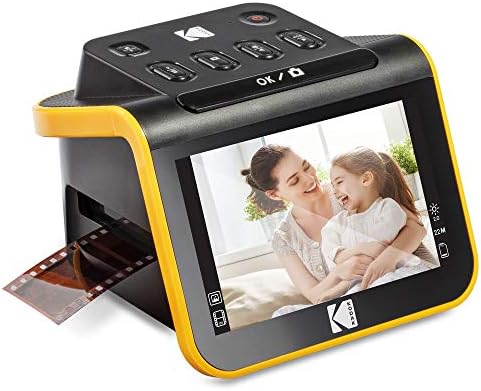
That shoebox of negatives and carousel of slides holds decades of memories, and a film scanner is the fastest way to get them onto your phone before the colors fade any further. The catch is that the megapixel number printed on the box is often not the number that decides how sharp your photos look. We analyzed thousands of verified buyer reviews, recent sales data, and expert evaluations to find seven film scanners that capture real detail and handle the formats actually sitting in your closet.
Our Best Overall pick: a tiltable 7-inch display with gallery mode, quick one-touch scanning and explicit support for black-and-white negatives that many rivals handle poorly.
22MP interpolated · 5" LCD · 135/126/110 film & slides
Kodak's mainstream film digitizer pairs a bright 5-inch LCD with one-touch scanning that converts 35mm, 126 and 110 negatives and slides in under two seconds each. It is a well-reviewed mainstream option with a smaller, cheaper body than the 7-inch Kodak.
48MP sensor · 5" touchscreen · 35mm, Super 8 & 8mm film
Our pick for high-resolution scans: the highest sensor megapixel count in this lineup (48MP) with the broadest film-format support, bundled with PictureStudio editing software.
HP's larger touchscreen digitizer scans standard negatives and mounted slides on a 7-inch tilting display, with mini-HDMI output for viewing scans on a bigger screen.
22MP interpolated · 5" touchscreen · 135/126/110 film & slides
HP's compact digitizer combines an all-angle 5-inch touchscreen with a 7-element lens, and hands-on testing found it fast and simple with pleasing image quality.
22MP interpolated · 3.5" LCD · 35mm, Super 8 & 8mm film
Kodak's original dedicated film digitizer trims the screen to 3.5 inches and the price to match, but keeps the same core film-to-JPEG conversion, plus support for Super 8 and 8mm movie film that most rivals skip.
A budget-friendly all-in-one digitizer that converts 35mm and 110 negatives, mounted slides and printed photos to JPEG on a 5-inch screen without a computer, with an 8GB SD card included in the box.
Short on time? These three cover most buyers: our top-graded Kodak with the biggest screen and black-and-white negative support, the budget-friendly pick, and the highest-resolution scanner with the broadest film-format support.
Understand the category before you buy - what the science actually says, and which specs matter.
Every scanner in this lineup promises to turn old film into digital photos, but how much true detail they capture, and which film types they accept, varies more than the marketing suggests. Here is how they work, why the headline megapixel figure can mislead you, and the features actually worth comparing.
What does a film scanner actually do?
A film scanner shines a light through your negative or slide and photographs it with a small digital sensor, then saves the result as a JPEG. You load the film into a tray or adapter, slide it into the machine, line up each frame on the built-in screen, and press one button to capture. Most models here work the same way:
A backlight illuminates the film from behind
A CMOS or CCD sensor captures the frame
Onboard software inverts negatives into a normal positive image
The finished photo saves to an SD card or built-in memory
The whole point is speed and independence. Instead of mailing film away or tethering a flatbed to a computer, you sit at the kitchen table and work through a stack at your own pace.
Why the box megapixels are not the whole story
This is the part worth understanding before you compare any two scanners. The big megapixel number on the front is frequently an interpolated figure, meaning the software mathematically inflates the image after capture by inventing pixels between the real ones. It does not add genuine detail, it just makes a bigger file.
The honest spec is the true optical resolution of the sensor itself. Look closely at this lineup and the pattern is clear: the KODAK Slide N SCAN and the SCANZA both list 14MP native alongside 22MP interpolated, and the HP 5-inch touchscreen model captures on a 13MP CMOS sensor while advertising 22MP interpolation. In each case the smaller number is the real one. A few units skip the trickery and quote a single genuine figure, like the 24MP CCD sensor in the Magnasonic FS71 or the 48MP CMOS sensor in the AMBIR FS550-TS. When you see two numbers, trust the native sensor resolution, because a scanner advertised at a huge megapixel count can capture far less actual detail than it claims.
Which specs actually matter?
Once you can read past the megapixel marketing, a few features decide which scanner fits your collection:
True optical resolution: The native sensor figure, not the interpolated one, sets how much real detail you capture. Ranges here run from 13MP and 14MP native up to genuine 24MP and 48MP sensors.
Film and slide formats: Check that it accepts what you own. Every model handles 135 (35mm) negatives and mounted slides, most add older 126 and 110 film, and a few, including the SCANZA and the AMBIR FS550-TS, also take Super 8 and 8mm movie film, with the Magnasonic FS71 handling Super 8.
Built-in screen size: A larger preview makes framing and focusing far easier. Screens here span 3.5 inches on the SCANZA up to a 7-inch tiltable LCD on the KODAK Slide N Scan Max and the HP 7-inch model.
Storage and standalone use: Saving straight to an SD card, up to 32GB on the KODAK units, means the scanner works on its own without a computer. Some, like the Magnasonic, add built-in memory as a backup.
Adapters and trays: The loading system decides how fast you move. Quick-feed trays and easy-load inserts speed up a big batch, and the included slide holders and film adapters determine which formats you can actually mount.
Connectivity: USB or USB-C moves finished files to your computer, and HDMI TV-out on several models lets you review scans on a television using the gallery mode.
How we grade products
Graded Picks rankings are aggregated from several independent signals: verified buyer ratings and the size of the review base for credibility, recent monthly purchase volume for relevance, assessments from trusted photography and home-tech publications, and how each product places in leading category lineups. For film scanners we weigh:
True optical sensor resolution over interpolated claims
Range of film and slide formats supported
Preview screen size and framing ease
Standalone operation and SD card handling
Loading system, trays, and included adapters
Color accuracy and negative inversion quality
Overall value for the price
Preservation note: A film scanner captures a copy, it does not repair the original, so clean each negative or slide with the included brush before scanning to keep dust from showing up in the final image. Store your originals somewhere cool and dry after digitizing, and keep at least two copies of the finished files, one on your computer and one backed up elsewhere, so a single lost card never costs you the memories twice.
In-Depth Reviews
Everything we learned from buyer reviews and expert testing, product by product.
KODAK Slide N Scan Max
Best Overall16% OFF
1. KODAK Slide N Scan Max Film Scanner (7" LCD)
5.0
Our Best Overall pick. The Slide N Scan Max upsizes Kodak's popular digitizer to a tiltable 7-inch LCD with gallery mode, useful both as a scanning preview and as an impromptu digital photo frame for reviewing a finished batch. Its 13-megapixel sensor interpolates to 22MP JPEGs across 135, 126 and 110 formats, and it explicitly supports black-and-white negatives alongside color, a format some competing digitizers handle poorly. A quick-feed tray speeds up scanning long strips of negatives, USB-C and SD/SDHC storage (up to 32GB) round out the connections, and reviewers describe operation as simple and scanning as quick, with brightness and RGB controls for fast fixes. Independent coverage is mixed on ultimate sharpness: scans look good in good light but fall short of a dedicated film scanner, and slide alignment takes practice without a sliding tray. For most buyers digitizing a mixed family archive, the large screen, speed and broad negative support make it the best-balanced choice in this lineup.
Sensor resolution13MP native / 22MP interpolated
Screen7" tiltable LCD with gallery mode
Film/slide formats135, 126, 110 color & B&W negatives, plus 50mm mounted slides
Output formatJPEG
Storage/mediaSD/SDHC card (up to 32GB)
ConnectivityUSB-C, HDMI TV-out
Included accessoriesQuick-feed tray, film adapters, slide holder
Pros
Tiltable 7-inch screen with gallery mode doubles as a review display
Explicit black-and-white negative support, not just color
Quick-feed tray speeds up scanning long negative strips
USB-C and SD/SDHC storage up to 32GB
Cons
Image quality is inconsistent - sharp in good light, soft under scrutiny
Costs more than the smaller 5-inch Kodak for a similar core sensor
No Super 8 or 8mm movie film support
Who is it for?
Most home archivists who want a large preview screen, quick scanning and reliable color and black-and-white negative support in one easy device.
Who is it not for?
Buyers who need movie film conversion (get the SCANZA) or maximum image fidelity beyond what any touchscreen digitizer in this lineup can match.
2. KODAK Slide N Scan Film & Slide Scanner (5" LCD)
4.9
The Slide N Scan digitizes 135, 126 and 110 negatives and 50mm mounted slides at a native 14 megapixels, upscaled to 22MP JPEGs, and independent testing clocked it scanning a 35mm frame in just under two seconds - among the fastest devices in this comparison. Its 5-inch LCD with gallery mode lets you preview, crop and adjust exposure before saving straight to an SD card, and an HDMI output can mirror the screen on a TV for group viewing sessions. Reviewers consistently call the color reproduction vibrant, though several note that fine detail looks noticeably softer than a flatbed or dedicated 35mm scanner, and there's no way to save an uncompressed file. Three film adapters, a 50mm slide holder, a cleaning brush and both USB and HDMI cables ship in the box, so it's ready to scan straight out of the case. For anyone digitizing a family archive of mixed negatives and slides without wanting to learn scanning software, it remains a dependable, well-reviewed choice.
Included accessories3 film adapters, 50mm slide holder, cleaning brush, USB/HDMI cables
Pros
Scans a 35mm frame in under two seconds - one of the fastest digitizers here
Bright 5-inch LCD with gallery mode for instant preview and light edits
Handles 135, 126 and 110 negatives plus 50mm slides with included adapters
HDMI output for viewing scans on a TV
Vibrant, punchy color reproduction straight out of the box
Cons
Detail looks noticeably softer than a dedicated film scanner under close inspection
JPEG-only output - no uncompressed RAW or TIFF option
Slide holder has no sliding tray, so precise alignment takes a little practice
Who is it for?
Anyone with a shoebox of mixed family negatives and slides who wants fast, good-enough digital copies without learning scanning software.
Who is it not for?
Archivists or anyone who needs maximum sharpness and uncompressed RAW/TIFF files - none of the touchscreen digitizers in this lineup output uncompressed files, so look to a dedicated flatbed or film scanner for that level of quality.
3. AMBIR FS550-TS Touch Screen Film & Slide Scanner
4.8
Our Best for High-Resolution Scans pick. The FS550-TS is built around a 48-megapixel CMOS sensor, well above the 13 to 14MP sensors most rivals use before interpolation, and it captures the widest format range here: 35mm, 110, 126, Super 8 and 8mm film plus 135, 126 and 110 slides. A 5-inch responsive touchscreen previews and lightly edits scans before they land on the included SD card or onboard memory, and Ambir bundles PictureStudio software for organizing and restoring images on a computer afterward. Ambir backs it with a 1-year warranty and positions it as a step up from entry Kodak models. It is a newer entrant with a thin public track record, so treat the megapixel spec as promising rather than proven: some owners report feeding trouble with printed photos, and independent lab testing is limited.
Sensor resolution48MP CMOS sensor
Screen5" responsive touchscreen
Film/slide formats35mm, 110, 126, Super 8 & 8mm film, plus 135/126/110 slides
Output formatJPEG
Storage/mediaOnboard memory + included SD card
ConnectivityUSB, HDMI
Included accessoriesPictureStudio editing software
Pros
Highest-resolution sensor in this comparison (48MP)
Widest film-format support: negatives, slides, Super 8 and 8mm in one unit
Responsive 5-inch touchscreen with onboard memory plus SD card
Bundled PictureStudio software for organizing and restoring scans
Cons
Newer product with limited independent testing to confirm real-world sharpness
PictureStudio software has a learning curve for first-time users
No larger 7-inch screen option like some competitors
Who is it for?
Buyers who want the highest sensor resolution and broadest film format support, including Super 8 and 8mm, and don't mind a newer product.
Who is it not for?
Buyers who prioritize a long track record and abundant independent testing over raw spec-sheet numbers.
4. HP FilmScan 7" Touch Screen Film & Slide Scanner
4.7
The HP FilmScan 7" targets buyers who want the biggest on-device screen in this lineup: a 7-inch tilting touchscreen for previewing and lightly editing 135, 126 and 110 negatives plus 50mm mounted slides before saving 22-megapixel JPEGs to an SD card. Mini-HDMI output lets you mirror scans on a TV for family viewing sessions, and USB-C handles direct computer transfer. Coverage from technology press has focused mainly on the launch specs rather than deep hands-on testing, so real-world sharpness is less independently verified than on its 5-inch sibling. It carries a real price premium over the smaller HP model for a bigger screen and the same core sensor, which is the trade-off to weigh.
5. HP FilmScan 5" Touch Screen Film & Slide Scanner
4.7
Hands-on testing from a major photography publication called the HP FilmScan 5" "smart, fast, simple and effective," praising its one-touch scanning and intuitive touchscreen over fumbling with a computer. A 13-megapixel CMOS sensor behind an f/3.5, seven-element lens captures 135, 126 and 110 negatives and 50mm mounted slides, outputting 22-megapixel interpolated JPEGs to an SD card via the 5-inch all-angle touchscreen's gallery mode. USB-C handles transfer to a computer when you want to edit further. The same review flagged two honest limits: scan sharpness trails a dedicated flatbed or film scanner, and the device can't rotate scans to portrait orientation on-screen, so vertical shots need cropping later. At its going price it undercuts the 7-inch HP model while sharing the same core sensor and lens.
Included accessoriesf/3.5 7-element lens, film/slide adapters
Pros
Praised in hands-on testing as fast, simple and effective to operate
7-element f/3.5 lens and all-angle touchscreen with gallery mode
USB-C plus SD card storage for flexible file transfer
Costs less than the 7-inch HP model with the same core sensor
Cons
Scan sharpness trails a dedicated flatbed or film scanner
No on-screen portrait rotation for vertical shots
No Super 8 or 8mm movie film support
Who is it for?
Buyers who want a compact, easy touchscreen digitizer for standard negatives and slides validated by hands-on press testing.
Who is it not for?
Anyone digitizing Super 8 or 8mm home movies - the SCANZA covers that - or anyone who needs maximum true optical resolution beyond what any touchscreen digitizer in this lineup offers.
The SCANZA was Kodak's first standalone digitizer and remains the category's budget benchmark: a 14-megapixel sensor (22MP interpolated) captures 135, 126 and 110 negatives plus Super 8 and 8mm movie film, converting each frame to a JPEG on a 3.5-inch LCD. Easy-load inserts and adapters cover more film formats out of the box than most rivals at this price, including the two motion-picture formats few competitors touch. Expert reviewers describe the output as respectable rather than sharp - fine for social sharing and family archives, less convincing at full-screen zoom - and note the smaller screen makes fine framing trickier than on 5-inch models. What keeps it recommended years after launch is reliability and value: it does the job Kodak designed it for at a price well below the newer touchscreen models in this lineup.
Sensor resolution14MP native / 22MP interpolated
Screen3.5" LCD
Film/slide formats135, 126, 110 negatives, Super 8 & 8mm film, plus 135/126/110 slides
Output formatJPEG
Storage/mediaSD card slot
ConnectivityUSB 2.0, HDMI TV-out
Included accessoriesEasy-load film/slide inserts and adapters
Pros
Converts Super 8 and 8mm movie film in addition to standard negatives
Budget-friendly price for a full-featured digitizer
Easy-load inserts speed up batch digitizing sessions
HDMI output and SD card storage included
Cons
3.5-inch screen is noticeably smaller than newer models, making fine framing harder
Output is respectable rather than sharp under close inspection
No touchscreen - navigation relies on physical buttons
Who is it for?
Budget-conscious buyers who also have old Super 8 or 8mm home movies to convert alongside standard negatives and slides.
Who is it not for?
Anyone who wants a larger, touch-enabled screen for easier framing and review - the 5-inch Kodak or HP models handle that better.
7. DigitPro M129A All-in-One Photo & Film Scanner (5" LCD)
4.6
It remains a solid budget-friendly option overall. DigitPro's M129A is a no-computer-required digitizer built for casual archive projects: load a 35mm or 110 negative, a mounted slide, or a printed photo (down to name-card size) into the appropriate adapter, and the 5-inch LCD lets you preview and capture the shot on the spot. An 8GB SD card ships in the box alongside built-in onboard memory, so there's no computer or extra purchase needed to get started, and a USB cable handles file transfer when you do want to move images to a computer. Independent coverage, including a hands-on review at Lim Team, positions it as an ultra-budget entry point rather than an archival-grade tool: the seller's own spec sheet lists both a 1080p sensor figure and a 22-megapixel output claim, a discrepancy that echoes the interpolated-resolution gap seen across this whole category, so treat the bigger number skeptically. Reviewers describe setup and operation as simple enough for a first-time user, with the trade-off being noticeably softer detail and dimmer color accuracy than the pricier Kodak and HP digitizers in this lineup. A 3-year warranty is longer than most rivals offer in this price range, and it undercuts every other digitizer here on price.
The stars you see are the Graded Picks cumulative score, not a single retailer's average. It blends verified buyer reviews aggregated across major retailers, assessments from professional reviewers and expert testers, and how prominently the product features in leading category lineups.
Advertising Disclosure
Our rankings are compiled by aggregating several independent signals, including verified buyer feedback, how popular a product currently is with shoppers, and evaluations published by professional reviewers. Editorial opinions are our own.
Please note that we participate in affiliate marketing programs. When you purchase through links on our site, we may earn a commission. As an Amazon Associate we earn from qualifying purchases. This comes at no additional cost to you and helps support the resources required to provide valuable content.