A spoonful of MCT oil in your morning coffee is supposed to hand you clean, fast energy and a sharper head, which is why it shows up in every keto and bulletproof routine. But not all MCT oil is the same, and the cheaper blends quietly deliver less of the fraction that does the real work. We analyzed thousands of verified buyer reviews, recent sales data, and expert evaluations to find six MCT oils that give you genuine fuel without the marketing fog.
Every product we compared, in ranked order. Tap through to Amazon to check today's price, or jump to the full review below.
1
Sports Research Organic MCT Oil, C8+C10+C12 (32 oz)
Best Overall16% OFF
Sports Research Organic MCT Oil, C8+C10+C12 (32 oz)
5.0
C8+C10+C12 blend · 1 Tbsp serving · 63 servings
A USDA Organic, coconut-derived MCT oil blending C8, C10, and C12 fatty acids for a steady, all-day energy release. Its squeeze bottle and flip cap make it one of the easiest liquid MCT oils to dose daily.
Sports Research MCT Oil Softgels, 3,000 mg C8+C10 (120 Count)
Best Affordable
Sports Research MCT Oil Softgels, 3,000 mg C8+C10 (120 Count)
4.9
3 softgels per serving · 3,000 mg · 40 servings
Tasteless softgels delivering 3,000 mg of C8+C10 MCTs per serving, at the lowest price per bottle in this lineup. A mess-free, travel-friendly alternative to liquid MCT oil.
A USDA Organic C8+C10 coconut MCT oil built for keto and bulletproof coffee, with a mild taste reviewers describe as odor-free. It skips C12 for a blend some keto dieters feel kicks in faster.
A USDA Organic MCT powder blending 70% C8 and 30% C10 with prebiotic fiber, built to dissolve cleanly into coffee without an oily film. Reviewers call out its creamy mixability as a standout over liquid MCT oil.
Micro Ingredients keeps this liquid MCT oil organic and third-party tested while pricing it below most other 32 oz bottles in this lineup, delivering 14 grams of C8+C10 MCTs per tablespoon. Each bottle holds about 61 servings and mixes into coffee, salads or smoothies.
A 95% C8 MCT powder, the highest caprylic-acid concentration in this lineup, built for a clean energy lift without the oily texture of liquid oil. Reviewers say it froths coffee rather than leaving a slick.
Short on time? These three cover most buyers - our Best Overall pick (Sports Research's full-spectrum C8+C10+C12 organic MCT oil), Nutricost's softgels for the lowest cost per serving, and Nutricost's C8 powder for the best way to mix into coffee.
Best Overall
Sports Research Organic MCT Oil, C8+C10+C12 (32 oz)
Sports Research Organic MCT Oil, C8+C10+C12 (32 oz)
Understand the category before you buy - what the science actually says, and which specs matter.
Every bottle promises energy, focus, and keto support, but the label breakdown behind that promise varies far more than the front of the label lets on. Here is how MCTs work, why the C8 number matters more than anything else, and the specs actually worth comparing.
What does MCT oil actually do?
MCT stands for medium-chain triglyceride, a type of fat that your body handles differently from the long-chain fats in most foods. Instead of a slow digestion route, MCTs travel quickly to the liver, where they are converted into ketones, a fuel your brain and muscles can burn right away. That is why people reach for it:
Fast, steady energy without a sugar crash
Ketones that support focus and mental clarity, especially on a low-carb or keto diet
An easy way to add fat to coffee, tea, smoothies, or a protein shake
Most MCT products are drawn from coconut, and every oil in this lineup is coconut-derived. You will see them sold three ways: as a liquid oil, like the Viva Naturals bottle, as a powder, like the Nutricost and Micro Ingredients tubs, which mix more smoothly into cold drinks and travel without leaks, or as softgel capsules, like the Sports Research and Nutricost capsules, for a pre-measured dose.
Not all MCT is the same: why the C8 number is what matters
This is the one thing most shoppers miss. "MCT" is an umbrella covering several fatty acids, mainly C8 (caprylic acid), C10 (capric acid), and C12 (lauric acid). They are not interchangeable. C8 is the fraction your body converts to ketones the fastest and most efficiently, so it delivers the cleanest hit of energy and focus per spoonful. C10 works too, just more slowly, and C12 behaves more like a regular coconut fat than a quick ketone source.
That means a pure C8 oil is the premium choice, while a C8 and C10 blend or a full-spectrum coconut mix still works, just less potently per serving. You can see the whole range in this lineup. The Nutricost powder is C8-concentrated at 95% C8, so it leans hard into the fast-acting fraction. The Micro Ingredients powder is a 70/30 C8 and C10 blend, a solid middle ground, and Viva Naturals' liquid oil is a C8+C10 blend that trades a little of that peak potency for the pourable convenience of a full 32 oz bottle. None of these is wrong. The point is to read the breakdown and match it to what you want, peak focus or an all-round everyday oil, rather than trusting the word "MCT" on the front.
Which specs actually matter?
Once you understand the C8 story, a few details decide which product fits you:
C8 percentage: This is the potency lever. A high-C8 option like the 95% C8 Nutricost powder gives you the most efficient ketone fuel per scoop; a full-spectrum or C8 and C10 blend is fine for general energy at a friendlier price.
Oil versus powder: Liquid oils are the purest form and easy to pour into coffee. Powders dissolve better in cold drinks and are easier to travel with than a liquid bottle.
Source: All six here are coconut-derived rather than a coconut and palm mix, which matters if you care about sustainability and a single clean origin.
Certifications: Look for USDA Organic and Non-GMO if that matters to you. The Viva Naturals and Micro Ingredients oils, along with the Micro Ingredients powder, are USDA Organic, and every product in this lineup is Non-GMO.
Flavor: Unflavored options like the Nutricost C8 powder and the Micro Ingredients liquid oil disappear into anything. A coconut note comes through in other formats, like the Nutricost softgels, and the Micro Ingredients powder carries its own coconut flavor rather than disappearing completely.
Size and serving: The liquid bottles here run 32 fl oz at 61-63 servings, while the powders run 45 servings per container, so factor cost per serving, not just sticker price.
Third-party testing: Because supplements are lightly regulated, independent lab testing for purity is worth more than any front-label claim.
How we grade products
Graded Picks rankings are aggregated from several independent signals: verified buyer ratings and the size of the review base for credibility, recent monthly purchase volume for relevance, assessments from trusted health and nutrition publications, and how each product places in leading category lineups. For MCT oils we weigh:
C8 concentration and the full fatty-acid profile
Source quality and coconut origin
Organic and Non-GMO certification
Third-party testing and purity
Format fit, oil or powder, and how cleanly it mixes
Flavor neutrality
Overall value per serving
Safety and usage note: MCT oil is potent, and taken too fast it commonly causes stomach upset, cramping, or loose stools. Start with a small serving, roughly half a tablespoon or less, and build up slowly over a couple of weeks as your gut adjusts. MCT oil is a fuel and a diet aid, not a weight-loss cure on its own, so treat any dramatic claim with skepticism. If you are pregnant, managing a liver condition, or taking medication, talk to a healthcare provider before adding it to your routine.
In-Depth Reviews
Everything we learned from buyer reviews and expert testing, product by product.
Sports Research Organic MCT Oil, C8+C10+C12 (32 oz)
Best Overall16% OFF
1. Sports Research Organic MCT Oil, C8+C10+C12 (32 oz)
5.0
Sports Research blends coconut-derived C8, C10, and C12 medium-chain triglycerides into a single clear, neutral-tasting oil designed for daily use in coffee, smoothies, or salad dressings. The broader fatty-acid spread trades some of the rapid energy spike of pure C8 oils for a steadier, longer sustained release, which many reviewers describe as easier on digestion when introduced gradually. The 32 oz bottle uses a squeeze design with a flip-top cap that resists dripping, a detail reviewers call out as more practical than a pour spout. Both the liquid and the sourcing are USDA Organic and Non-GMO Verified, meeting the strictest certification many buyers look for in a daily supplement. As with any MCT oil, new users are advised to start with a small amount and build up gradually to avoid stomach discomfort.
Broad C8+C10+C12 blend suits users who want a milder, sustained energy curve rather than a sharp C8 spike
Squeeze bottle with no-spill flip cap makes daily dosing easy
USDA Organic and Non-GMO Verified sourcing
Neutral taste blends cleanly into coffee or smoothies
Large 32 oz size keeps cost per serving low for daily users
Cons
The C12 (lauric acid) content converts to ketones less readily than pure C8, so the energy effect is gentler than C8-only oils
Liquid form can dissolve foam or plastic cups if left in contact too long; glass or metal only
Higher doses may cause digestive upset for sensitive users starting out
Who is it for?
Anyone wanting a well-rounded, everyday MCT oil to add to coffee or smoothies who prioritizes organic sourcing and easy dosing over the sharpest possible energy spike.
Who is it not for?
Keto dieters chasing the fastest ketone response, who should look for a higher-percentage C8 formula instead.
Sports Research packages its C8 and C10 MCT blend into tasteless softgels, each serving of three capsules delivering 3,000 mg of medium-chain triglycerides without the oily mouthfeel of liquid versions. At under $17 for 120 capsules, it is the most affordable option in this lineup while still carrying the same Non-GMO Verified and Keto Certified sourcing as pricier liquid oils. Reviewers favor the softgels for travel and for avoiding the mess that comes with pouring oil into coffee at a desk or gym. The tradeoff is dosing convenience: three capsules per serving is slower than a single tablespoon, and the 40-servings-per-bottle count means more frequent reorders for daily users. Several reviewers note the capsules also sidestep the digestive discomfort that liquid MCT oil can cause when taken on an empty stomach.
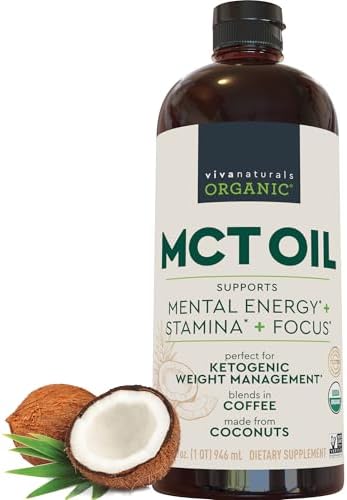
Viva Naturals sticks to a two-fatty-acid C8+C10 blend sourced from coconuts, a narrower profile than triple-blend oils that keto dieters often prefer for a faster shift into ketosis. The oil is mild-tasting and odorless, a quality reviewers consistently highlight when describing how it mixes into bulletproof coffee or smoothies without an oily aftertaste. Each tablespoon serving provides about 130 calories and 14 grams of fat, with zero carbs or protein, in line with what is advertised on the label. Both the oil and its coconut sourcing carry USDA Organic and Non-GMO certification. At just under $30 for 32 oz it sits at the higher end of this lineup's pricing, though reviewers generally consider the quality to justify the cost for regular keto use.
BrandViva Naturals
MCT BlendC8 + C10 (coconut-derived)
Size32 fl oz (946 ml)
Serving Size1 Tbsp (15 ml)
Servings Per Container63
CertificationsUSDA Organic, Non-GMO
Calories Per Servingabout 130 kcal, 14 g fat (advertised)
Pros
Pure C8+C10 blend without C12, favored by keto users chasing a quicker ketone response
Mild taste and no odor, reviewers say it blends cleanly into bulletproof coffee
USDA Organic and Non-GMO certified sourcing
Large 32 oz bottle covers roughly two months of daily use
Cons
Priced at the high end of this lineup for a 32 oz liquid oil
Leans more heavily on C10 than some competing blends, which some keto users feel softens the speed of the energy effect versus a higher-C8 ratio
Can cause stomach cramps in some users if introduced at full-tablespoon doses too quickly
Who is it for?
Keto and intermittent-fasting dieters who want a straightforward C8+C10 liquid oil for bulletproof coffee without the added C12 found in broader blends.
Who is it not for?
Buyers comparing strictly on price, since this bottle sits near the top of this lineup's cost range.
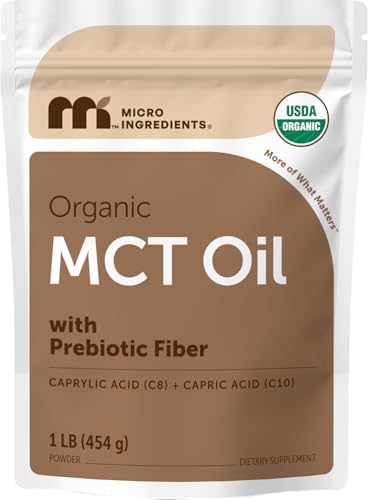
Micro Ingredients powders its MCT blend, 70 percent C8 and 30 percent C10, together with acacia-derived prebiotic fiber, aiming at buyers who want the energy benefits of MCT oil without the oily residue liquid versions can leave in a mug. Reviewers consistently praise how cleanly it dissolves into hot coffee, describing a creamy texture rather than the separated oil slick that liquid MCT can produce. The organic certification extends across both the MCT source and the fiber additive. Most reviewers enjoy the mild coconut flavor, though a small number find it too pronounced for plain black coffee. At 45 servings per 16 oz tub it runs through faster than the 32 oz liquid oils in this lineup, a tradeoff for the added convenience and gut-health ingredient.
BrandMicro Ingredients
MCT Blend70% C8 / 30% C10, powdered
Added IngredientPrebiotic fiber (acacia)
Size16 oz (454 g)
Serving Size1 scoop (10 g)
Servings Per Container45
CertificationsUSDA Organic
Pros
Powder form mixes into hot or cold coffee without the oily film liquid MCT leaves behind
Added prebiotic fiber is a gut-health bonus liquid oils don't offer
Mild coconut flavor that most reviewers find pleasant rather than overpowering
USDA Organic certified
Cons
45 servings per 16 oz tub is fewer uses than the 32 oz liquid oils in this lineup
A minority of reviewers find the coconut flavor too strong for unflavored coffee
Powder can clump if not mixed with enough liquid or a frother
Who is it for?
Coffee and smoothie drinkers who want an oil-free powder that mixes cleanly without residue, plus a prebiotic fiber bonus for gut health.
Who is it not for?
Anyone who wants the longest-lasting container per dollar, since the 45-serving tub runs through faster than the 32 oz liquid options here.
This oil blends caprylic acid (C8) and capric acid (C10) sourced from organic coconuts, delivering 14 grams of MCTs per one-tablespoon serving, a figure in line with other organic liquid MCT oils in this lineup. Micro Ingredients manufactures it in a cGMP-compliant facility and has it third-party lab tested for purity, while keeping the retail price below comparable organic bottles of the same size. The oil pours easily into coffee, salad dressings or smoothies and has little flavor of its own, so it does not change the taste of what it is added to. Like other liquid MCT oils, Micro Ingredients recommends starting with a smaller amount, around a teaspoon, before working up to a full tablespoon to avoid digestive discomfort. The 32 oz bottle is a roughly two-month supply at the suggested one-tablespoon daily serving, and the product is free of soy, dairy and gluten.
Nutricost's C8 powder is formulated to 95 percent caprylic acid, the highest C8 concentration of any powder in this lineup, aimed squarely at keto dieters chasing the fastest possible shift into ketosis. Reviewers consistently describe a clean, steady energy lift without the stomach upset some report from liquid MCT oil, and note that it froths coffee rather than leaving an oily sheen. It is produced in a GMP-compliant, FDA-registered facility and carries Non-GMO and gluten-free claims. Because it is unflavored, some reviewers pair it with a sweetener or flavored creamer rather than drinking it plain. As with other high-concentration MCT products, a few users report stomach cramps or nausea when taking it on an empty stomach, so starting with a half scoop is the commonly recommended approach.
BrandNutricost
MCT Blend95% C8 (caprylic acid), powdered
Size16.2 oz (459 g)
Serving Size1 scoop (rated about 5.5 g)
Servings Per Containerabout 83 (advertised)
CertificationsNon-GMO, gluten-free
FacilityGMP-compliant, FDA-registered
Pros
Highest C8 concentration of any powder in this lineup at 95%, which reviewers say produces a cleaner, steadier energy lift than lower-C8 blends
Powder form avoids the oily texture and plastic-dissolving risk of liquid MCT oil
No noticeable aftertaste, reviewers say it makes coffee frothier rather than oily
Budget-friendly pricing relative to other C8-forward powders
Cons
Unflavored only, so some reviewers add their own sweetener or flavoring
Taking it before eating can trigger stomach cramps or nausea in sensitive users
A smaller jar size than the liquid oils in this lineup means more frequent reorders for daily users
Who is it for?
Keto and intermittent-fasting users who specifically want the purest, highest-percentage C8 formula for the fastest ketone response, without the oily mouthfeel of liquid MCT.
Who is it not for?
Anyone wanting a pre-flavored powder, since this is unflavored only and needs to be paired with coffee or a smoothie that already has flavor.
The stars you see are the Graded Picks cumulative score, not a single retailer's average. It blends verified buyer reviews aggregated across major retailers, assessments from professional reviewers and expert testers, and how prominently the product features in leading category lineups.
Advertising Disclosure
Our rankings are compiled by aggregating several independent signals, including verified buyer feedback, how popular a product currently is with shoppers, and evaluations published by professional reviewers. Editorial opinions are our own.
Please note that we participate in affiliate marketing programs. When you purchase through links on our site, we may earn a commission. As an Amazon Associate we earn from qualifying purchases. This comes at no additional cost to you and helps support the resources required to provide valuable content.