A good home projector turns a blank wall into a 100-inch theater for a fraction of what a TV that size would cost, and the newest models stream Netflix, focus themselves, and square up the picture on their own. But projector boxes are famous for two inflated numbers that make a weak unit look mighty, and once you can read past them the shopping gets much simpler. We analyzed thousands of verified buyer reviews, recent sales data, and expert evaluations to find seven projectors that put a bright, sharp picture on the wall and stream without a fight.
Every product we compared, in ranked order. Tap through to Amazon to check today's price, or jump to the full review below.
1
HAPPRUN JQ820
Best Overall25% OFF
HAPPRUN JQ820 2000 ANSI Auto-Focus Projector
5.0
2,000 ANSI · 1080p native · auto focus
HAPPRUN's step-up model: a 2,000 ANSI lumen rating, auto focus with 6D keystone and AI obstacle avoidance, 4K input decoding and bidirectional Bluetooth 5.2 - 25% off at our last scan.
HAPPRUN 510G Google TV 4K-Supported Smart Projector
4.9
1080p native · Google TV built-in · 350 ANSI lumens
HAPPRUN's outdoor-minded Google TV projector, with officially licensed Netflix and thousands of apps built in, 4K input support with HDR10+, WiFi 6 and Bluetooth 5.2. It is advertised at 350 ANSI lumens, so it is a dusk-to-dark machine.
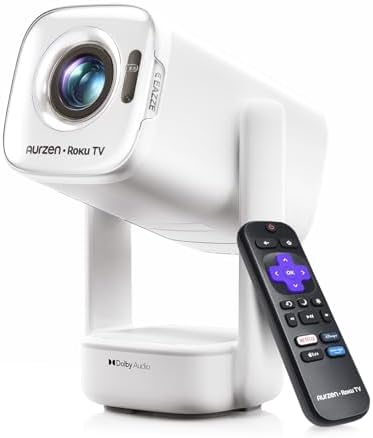
Roku TV built-in · USB-C powered · 300 ANSI lumens
A native Roku TV projector that runs off any 65W+ USB-C power source, including a power bank, with instant auto focus and official AirPlay, now $149.98 after a 38% discount.
Among the first projectors with Roku TV built natively into the hardware. Reviewers at Pocket-lint, Expert Reviews and Android Authority praise its zero-fuss setup, drop it on a table, it auto-focuses, auto-keystones and signs into Roku.
ONOAYO ONO5 Pro 2.0 4K-Support Smart Projector (60W Dolby)
4.7
1080p native · 60W Dolby audio · WiFi 6
Our Best for Home Theater pick: ONOAYO's larger, sound-focused projector, with Smart OS 2.0 and officially licensed apps, 60W Dolby-certified stereo speakers, the biggest sound in this lineup, and a sealed dust-resistant optical engine with 3-second auto calibration.
ONOAYO ONO3 Pro Portable Smart Projector (50W Dolby)
4.6
1080p native · 50W Dolby audio · handheld size
The ONOAYO with the widest buyer following in this lineup, pairing the same licensed-app Smart OS 2.0 and 3-second AI auto focus as its larger ONO5 Pro sibling, with a still-strong 50W Dolby audio pair in a genuinely handheld body.
Aurzen BOOM mini Google TV Smart Projector (Rotating Stand)
4.6
Google TV built-in · 500 ANSI lumens · 180° rotating stand
A self-contained Google TV projector with its own 180-degree rotating stand, no tripod or mount needed, plus 20W Dolby Audio speakers and real-time ToF auto focus. The Gadgeteer's hands-on review calls the picture crisp, with occasional lag noted in the Google TV interface itself.
Short on time? These three cover most buyers: our Best Overall ONOAYO ONO5 Pro 2.0 with 60W Dolby sound, the FUDONI P1, our Best Affordable pick at the lowest price in this lineup, and the HAPPRUN J7 Pro, our Best for Home Theater pick with Google TV and a bright 1,500 ANSI picture.
Understand the category before you buy - what the science actually says, and which specs matter.
Every projector promises a huge, crisp, movie-night image, but the way brightness and resolution get advertised can flatter a modest machine. Here is how a projector works, the two spec games to watch for, and the features that genuinely decide how good it looks.
What does a projector actually do?
A projector shines light through a small imaging chip and a lens to throw a large picture onto a wall or screen. A modern smart projector bundles a few jobs into one box:
It generates the image from a built-in light source and chip, at a fixed native resolution.
It runs a streaming operating system, so apps like Netflix, YouTube, and Prime Video live right on the projector.
It handles setup with auto focus and auto keystone, which sharpen the image and straighten a tilted picture into a clean rectangle.
It plays sound through built-in speakers and sends audio out over Bluetooth.
The lineup spans pocketable models like the Aurzen EAZZE D1R air up to big-room units like the ONO5Pro that throws up to 500 inches.
The two numbers on the box that mislead you, and how to read them
Two specs get inflated on nearly every projector listing, and both point you the wrong way if you take them at face value.
The first is brightness. The honest figure is ANSI lumens, a standardized measurement of light actually landing on the screen. Many listings instead quote a bigger "LED lumens" or "light source lumens" number that describes the raw lamp, not the picture, and it can read two to three times higher than the real output. The HAPPRUN J7 Pro here is quoted at an honest 1,500 ANSI lumens, while the ONO5Pro's "3,500 lumens" works out to about 2,500 ANSI per testers. A projector under a few hundred ANSI lumens, like the 350-lumen dark-room-class model here, is a lights-off machine, not a daytime one.
The second is resolution. Native resolution is the real pixel grid the chip projects, and it is what decides sharpness. "Supports 4K" is not the same thing: it means the projector accepts a 4K signal and then downscales it to fit a lower native grid. A native 1080p projector will look sharper than a 480p or 720p unit that advertises "4K" input. Every projector in this lineup is native 1080p, the sweet spot for the money, so read the "4K input support" lines on the ONOAYO, HAPPRUN 510G and YOWHICK DP03-L as compatibility, not as a 4K picture. After those two numbers, the light source and the throw quietly shape the rest.
Which specs actually matter?
A few features decide which projector fits your room:
Brightness in ANSI lumens: Your daylight lever. Higher ANSI figures like the HAPPRUN J7 Pro's 1,500 hold up with some ambient light; a few hundred ANSI lumens wants a dark room.
Native resolution: Buy on the native number, 1080p across this lineup, and treat any "4K support" line as signal compatibility, not picture quality.
Light source: LED and laser engines last tens of thousands of hours with no bulb to swap, so most buyers never replace one, while older lamp designs dim over time and eventually need a new bulb.
Throw and image size: Check the size range against your room, from the tighter 40 to 200 inches on compact models like the Aurzen EAZZE D1R air and the HAPPRUN J7 Pro out to 50 to 500 inches on the ONO5Pro, so the picture fills your wall from where you can place it.
Smart OS and streaming: Built-in Roku TV, as on the Aurzen EAZZE D1R air, or Google TV, as on the HAPPRUN J7 Pro, saves you a dongle; the FUDONI P1 has no built-in apps and expects WiFi mirroring or a TV stick. Auto focus and auto keystone, standard on most of this lineup, keep setup to a step-on affair.
Connectivity and audio: Look for current WiFi and Bluetooth, up to WiFi 6 and Bluetooth 5.3 here, plus HDMI and USB, and speakers strong enough to skip a soundbar, like the 60W Dolby system on the ONO5Pro.
How we grade products
Graded Picks rankings are aggregated from several independent signals: verified buyer ratings and the size of the review base for credibility, recent monthly purchase volume for relevance, assessments from trusted home theater publications, and how each product places in leading category lineups. For projectors we weigh:
Real brightness in ANSI lumens
Native resolution and image sharpness
Light source type and rated lifespan
Throw flexibility and usable image size
Smart OS quality and app support
Auto focus and keystone reliability
Overall value for the price
Room and placement note: A projector's picture is only as good as the room around it. Even a bright unit washes out in direct light, so plan for a wall or screen you can darken, and measure your throw distance before you buy so the image fills the space without overshooting it. Give the projector airflow too, since blocked vents shorten the life of the light source and fan.
In-Depth Reviews
Everything we learned from buyer reviews and expert testing, product by product.
HAPPRUN JQ820
Best Overall25% OFF
1. HAPPRUN JQ820 2000 ANSI Auto-Focus Projector
5.0
The JQ820 is HAPPRUN's step up for buyers who find entry-level budget projectors too dim: a 2,000 ANSI lumen rating puts it in this lineup's bright tier, capable of a watchable picture with some lights on where budget dark-room units demand blackout curtains. Setup automation is the other upgrade - auto focus, 6D auto keystone, AI obstacle avoidance and auto screen alignment sort the image within seconds whether it sits on a table, shelf or ceiling mount - and reviewers at Techxreviews credit its 20,000:1-rated contrast and 95% color gamut for a vivid, detailed image. A 25% limited-time deal brought it to $268.96 at our last scan. Trade-offs are real: there is no licensed app store, so streaming means casting or a TV stick; the built-in 8W speaker is the weakest audio here (Bluetooth 5.2 pairs an external speaker easily); and some owners report the autofocus struggles at steep angles and the fan intrudes in quiet scenes.
Native resolution1080p (1920 x 1080), 4K input support
Brightness (advertised)2,000 ANSI lumens
Smart OS & streamingWiFi casting; add a TV stick for Netflix and apps
Built-in audio8W built-in speaker, bidirectional Bluetooth 5.2
ConnectivityWiFi, Bluetooth 5.2, HDMI, USB, 3.5mm
Max image sizeUp to 300 inches (50-300")
Warranty2 years
Pros
2,000 ANSI rating - usable with some ambient light
Full auto setup: focus, 6D keystone, obstacle avoidance, screen alignment
4K input decoding with 20,000:1-rated contrast
Bidirectional Bluetooth 5.2 for speakers or headphones
25% discount at our last scan
Cons
Weak 8W built-in speaker needs external audio for movie nights
No licensed apps - streaming requires a stick or casting workarounds
Owners report fan noise in quiet scenes and autofocus hunting at steep angles
Who is it for?
Buyers who want real brightness and hands-off setup from an established budget brand and already own a Fire TV or Roku stick.
Who is it not for?
One-box streamers - the Aurzen units need no stick - and anyone who wants strong built-in audio without adding an external speaker.
2. HAPPRUN 510G Google TV 4K-Supported Smart Projector
4.9
The 510G is HAPPRUN's entry-level Google TV projector, built for backyard and bedroom movie nights. An officially licensed Google TV system runs on the projector itself, so Netflix and other apps launch from one remote with no streaming stick, and it also supports Google Cast and AirPlay for casting from a phone. The picture is a native 1080p image that accepts 4K signals and decodes HDR10+, with a rated 20,000:1 contrast ratio. Brightness is advertised at 350 ANSI lumens, which is honest but modest, so plan on a dark room or a night-time patio rather than daylight. Wireless is current, with dual-band WiFi 6 and two-way Bluetooth 5.2, and the listing describes Dolby-enhanced sound from a small built-in speaker, so an outdoor crowd may want an external speaker. Next to the ONOAYO ONO5 Pro 2.0, our Best for Home Theater pick, it gives up some brightness, and it adds Google TV that budget-tier projectors without a built-in smart OS lack.
Native resolution1080p (1920 x 1080), 4K input support
A capable native Roku TV projector in its own right. The D1R air packages Roku TV natively into the hardware, so every major streaming app plus official AirPlay and Android mirroring work out of the box with one remote and no dongle. Reviewers at Pocket-lint, CGMagazine, AndroidGuys, Android Authority and New Atlas all covered it and largely agree: TOF real-time auto focus and auto keystone lock in the picture with zero manual input. Its headline trick is power flexibility - it runs on any 65W-or-better USB-C PD source, including a portable power bank, so it travels further than plug-only projectors, though testers note it has no built-in battery of its own. A 38% discount brings it to $149.98 at our last scan, one of the lower prices in this comparison for a native smart-streaming projector. At an SGS-certified 300 ANSI lumens it looks genuinely good once the room goes dark, best suited to a dedicated home theater setup rather than a daytime one, and reviewers consistently flag one real drawback: noticeable fan noise during operation.
Smart OS & streamingRoku TV built-in + official Apple AirPlay & Android mirroring
Built-in audio2x5W Dolby Audio speakers
ConnectivityUSB-C PD power input, dual-band WiFi, Bluetooth, HDMI
Max image sizeUp to 150 inches (40-150")
Warranty1 year
Pros
Runs on any 65W+ USB-C PD source, including a portable power bank
Native Roku TV plus official AirPlay and Android mirroring
TOF real-time auto focus and auto keystone need zero manual input
Reviewed positively by Pocket-lint, CGMagazine, AndroidGuys, Android Authority and New Atlas
38% discount at our last scan makes licensed streaming genuinely affordable
Cons
Noticeable fan noise during operation, per multiple testers
No built-in battery - needs a power bank or outlet to run cordlessly
300 ANSI lumens is dark-room only - fine for movie night, not a daytime picture
Who is it for?
Renters, families and first-time projector buyers who want big-screen movie nights with TV-simple Roku streaming and zero setup fiddling, plus the flexibility to run off a power bank for camping or backyard nights.
Who is it not for?
Anyone who wants a self-contained battery-powered projector, or the brighter home-theater-ready picture of the ONOAYO models here.
4. Aurzen EAZZE D1R Roku TV Smart Projector (1080p)
4.7
The EAZZE D1R nails the thing budget projectors usually fumble: the software. Roku TV is built natively into the hardware, with no dongle and no sideloaded apps, so every major streaming service works with one familiar remote, and official Apple AirPlay covers iPhone casting. A 35% Prime-exclusive discount brought it to $139.99 at our last scan. Professional coverage is unusually strong for this price class: Pocket-lint, Expert Reviews and Android Authority all tested it, crediting sharp 1080p detail and balanced, natural colors from a good source. The honest limit is light output: Aurzen quotes 323 ISO lumens, so this is an evenings-and-dark-rooms projector best suited to a dedicated home theater setup rather than a daytime one.
Native resolution1080p (1920 x 1080)
Brightness (advertised)323 ISO lumens (manufacturer-quoted)
Smart OS & streamingRoku TV built-in + official Apple AirPlay
Built-in audioDolby Audio speaker, Bluetooth audio out
ConnectivityWiFi, Bluetooth, HDMI, USB
Max image sizeUp to 200 inches (40-200")
Warranty1 year
Pros
Native Roku TV: every major app with one remote, zero dongles
Sharp 1080p detail with balanced, natural colors from a good source
Reviewed and recommended by Pocket-lint, Expert Reviews and Android Authority
3-second auto focus and auto keystone setup
Official Apple AirPlay support for easy iPhone casting
Cons
323 ISO lumens needs a dark room, washes out in daylight
No HDMI cable in the box
Built-in speaker trails bigger 50-60W rivals, plan on a Bluetooth speaker outdoors
Who is it for?
Renters, families and first-time projector buyers who want big-screen movie nights with TV-simple streaming and no setup fiddling.
Who is it not for?
Anyone who needs a bright-room or daytime picture, the 2,000+ ANSI class units elsewhere in this lineup (HAPPRUN J7 Pro, ONOAYO) handle ambient light far better.
5. ONOAYO ONO5 Pro 2.0 4K-Support Smart Projector (60W Dolby)
4.7
The ONO5 Pro is our Best for Home Theater pick and the larger of ONOAYO's two entries here, and its calling card is sound: the 60W Dolby-certified stereo pair is the most powerful in this comparison, and YouTube testers consistently note it fills a room without an external speaker. The VisionIQ system (auto focus, keystone, obstacle avoidance and screen alignment) locks in a sharp image within about 3 seconds, and the fully sealed optical engine guards against the dust blobs that plague open budget projectors. The listing's "3500 bright" figure is marketing; independent tester coverage pegs real output around 2,500 ANSI lumens, which still puts it in the bright tier of this lineup. At $296.95 it undercuts its more portable ONO3 Pro sibling while matching it on the licensed-app smart OS and fast auto-calibration, and its bigger speaker array and sealed optical engine are the reasons to pick it over that sibling, even though the ONO3 Pro carries the wider buyer following of the two.
Native resolution1080p (1920 x 1080), 4K input support
Brightness (advertised)3,500 lumens (about 2,500 ANSI per testers)
Smart OS & streamingSmart OS 2.0 with officially licensed apps
500-inch max image claim is theoretical, usable size tops out far smaller
Who is it for?
Buyers who want the biggest all-in-one sound and a bright-tier picture ONOAYO offers, for living rooms and patio movie nights, at a price below its ONO3 Pro sibling.
Who is it not for?
Anyone who wants the ONO3 Pro's more compact, handheld form factor, or dark-room-only viewers who can save $150+ with a cheaper budget projector.
6. ONOAYO ONO3 Pro Portable Smart Projector (50W Dolby)
4.6
The ONO3 Pro is the more portable of ONOAYO's two entries here, and it carries the broadest, most consistent buyer following of any projector we compared, a track record that stands out even next to its own bigger ONO5 Pro sibling. The recipe is nearly identical to that sibling: a native 1080p panel with 4K input decoding, the same licensed-app smart OS, WiFi 6, bidirectional Bluetooth 5.2 and 3-second AI auto focus with keystone correction, all in a handheld body built for grab-and-go use. It does give up two things to the larger ONO5 Pro: audio drops from 60W to a still-strong 50W Dolby-certified pair, and advertised brightness drops from 3,500 to 3,000 lumens, a claim reviewers note runs well above measured output, so treat it as a dim-the-lights projector rather than a daylight one. At $365.99 it costs more than its ONO5 Pro sibling despite the smaller body and lighter spec sheet, but the portable form factor, consistent smart-OS experience and wide buyer adoption still make it a strong choice for anyone who wants a genuinely handheld ONOAYO.
Native resolution1080p (1920 x 1080), 4K input support
ConnectivityWiFi 6, Bluetooth 5.2, HDMI, USB, 3.5mm
Max image sizeUp to 400 inches (60-400")
Warranty1-year return, 3-year repair
Pros
Widest, most consistent buyer following in this lineup
50W Dolby-certified stereo, strong sound for a handheld projector
3-second AI auto focus with keystone correction
Licensed streaming apps plus WiFi 6 and Bluetooth 5.2
Handheld, genuinely portable design
Cons
Advertised 3,000 ANSI rating is optimistic versus independent measurements
Costs more than the ONO5 Pro sibling despite lower advertised brightness and audio power
AI keystone can hunt on steeply angled placements
Who is it for?
Buyers who want ONOAYO's most broadly trusted, portable projector, with a proven track record, licensed streaming and solid sound in a genuinely handheld body.
Who is it not for?
Anyone who wants the single biggest sound and brightness the brand offers: that is the ONO5 Pro, which gives up the handheld body for it.
7. Aurzen BOOM mini Google TV Smart Projector (Rotating Stand)
4.6
The BOOM mini is Aurzen's self-contained take on Google TV projection: a built-in stand rotates a full 180 degrees, so it throws a picture onto a wall, ceiling or angled surface without a tripod or mounting bracket. The Gadgeteer's hands-on review praises the crisp native 1080p image, HDR10 depth and surprisingly capable 20W Dolby Audio speakers that fill a bedroom or living room without an external speaker. Real-time ToF auto focus locks in the picture as soon as you reposition it, and Family Mode plus voice control round out the Google TV experience, Netflix, Prime Video, YouTube and thousands of other apps launch natively with one remote. The honest limiting factor reviewers flag is that the Google TV interface itself can lag a second or two when navigating menus, a software quirk rather than a picture-quality one. At a 500 ANSI lumen rating it sits in this lineup's mid brightness tier, watchable with some ambient light, best in a dimmed room, and Aurzen backs it with a 2-year manufacturer warranty.
Native resolution1080p (1920 x 1080), 4K input support
Brightness (advertised)500 ANSI lumens
Smart OS & streamingGoogle TV built-in with Voice Control & Family Mode
Built-in audio20W Dolby Audio speakers
ConnectivityWiFi, Bluetooth, HDMI, USB, 3.5mm
Max image sizeUp to 200 inches (40-200")
Warranty2 years
Pros
Self-contained 180-degree rotating stand, no tripod or mount needed
Google TV built in: Netflix, Prime Video and YouTube with one remote
Real-time ToF auto focus locks in within seconds after repositioning
HDR10 decoding adds visible depth versus this lineup's non-HDR budget units
Cons
Google TV's on-screen menus can lag a second or two, per reviewer feedback
500 ANSI lumens is mid-tier here, best with the lights dimmed, not full daylight
Family Mode and voice control add setup steps casual buyers may not need
Who is it for?
Buyers who want Google TV's full app ecosystem in a projector that sets itself up anywhere, ceiling, wall or angled surface, without extra hardware.
Who is it not for?
Anyone who wants the brightest possible daylight picture, or the widest independent review trail, the ONOAYO models above have more established coverage.
The stars you see are the Graded Picks cumulative score, not a single retailer's average. It blends verified buyer reviews aggregated across major retailers, assessments from professional reviewers and expert testers, and how prominently the product features in leading category lineups.
Advertising Disclosure
Our rankings are compiled by aggregating several independent signals, including verified buyer feedback, how popular a product currently is with shoppers, and evaluations published by professional reviewers. Editorial opinions are our own.
Please note that we participate in affiliate marketing programs. When you purchase through links on our site, we may earn a commission. As an Amazon Associate we earn from qualifying purchases. This comes at no additional cost to you and helps support the resources required to provide valuable content.