A solar security camera is supposed to be the one you mount and forget: no wiring to run, no battery to pull down and recharge every few weeks, just a small panel quietly topping it off in the sun. But that promise only holds if you hang it in the right spot, and the cheap ones can leave you with a dead camera in a shady corner or grainy black-and-white footage the moment it gets dark. We analyzed thousands of verified buyer reviews, recent sales data, and expert evaluations to find seven solar cameras that actually stay charged and show you something useful.
Every product we compared, in ranked order. Tap through to Amazon to check today's price, or jump to the full review below.
1
AOSU 2K 1-Pack
Best Overall13% OFF
AOSU 2K Wire-Free Solar Camera (Fixed Panel, 1-Pack)
4.9
2K · fixed solar panel · built-in storage
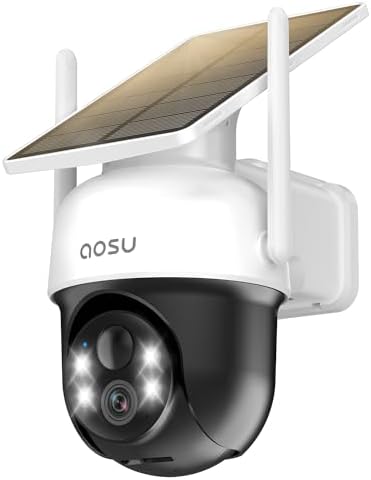
A one-piece 2K camera with the solar panel built into the housing, 360-degree panoramic view, human auto tracking and built-in storage with no SD card or hub needed, priced at $59.49 after 13% off and the cheapest way into solar security in this comparison.
ANSQUE GU01 2K solar camera kit, four cameras with a local-storage Homebase hub.
13% OFF
ANSQUE GU01 2K Solar Camera Kit (4-Cam)
4.9
4 cameras · 2K PTZ · 32GB base included
The ANSQUE GU01 pairs four 2K pan-tilt-zoom cameras with a Homebase hub that stores up to 120 days of footage locally. Cross-camera tracking and 6x digital zoom give it reach that plain 360 degree cameras lack.
eufy SoloCam S340 dual-lens 3K solar camera with 360 degree pan and tilt tracking.
Best Single Camera
eufy SoloCam S340 3K Dual-Lens Solar Camera
4.7
Dual-lens 3K+2K · 360° pan & tilt · solar powered
The eufy SoloCam S340 pairs a 3K wide lens with a 2K telephoto lens on one solar-powered, pan-and-tilt body, our Best Single Camera pick. Its dual-lens design and full 360 degree tracking stand out among the one-camera options here.
REOLINK Argus PT Ultra 4K solar camera with 355 degree pan and tilt tracking.
16% OFF
REOLINK Argus PT Ultra 4K Solar Camera (White, 1-Cam)
4.7
4K/8MP · 360° pan & tilt · up to 512GB microSD
The REOLINK Argus PT Ultra delivers 4K/8MP video, the sharpest resolution in this lineup, on a 355 degree pan and 140 degree tilt body. Dual-band Wi-Fi and person, vehicle and pet detection round out a camera built for a single high-value vantage point.
eufy SoloCam E30 2K solar camera with 360 degree pan and AI auto tracking.
Best Affordable33% OFF
eufy SoloCam E30 2K Pan-Tilt Solar Camera
4.7
2K · 360° pan · up to 128GB microSD
The eufy SoloCam E30 brings 360 degree pan and tilt tracking and solar charging in at the lowest price in this lineup, our Best Affordable pick. A wide f/1.6 lens and AI auto tracking punch above its price point.
REOLINK Argus PT 5MP solar camera, bundled with its solar panel.
REOLINK Argus PT 5MP Solar Camera with Solar Panel (1-Cam)
4.6
5MP · 360° pan & tilt · up to 512GB microSD
The REOLINK Argus PT 5MP ships with its solar panel included, pairing a 355 degree pan and 140 degree tilt motor with dual-band Wi-Fi. Its metal-aluminum build and 6,500mAh battery are built for exposed, large-yard placements.
Hiseeu 4-camera solar security kit with a 10-inch touchscreen hub and 500GB storage.
Hiseeu 4-Camera Solar Security Kit (500GB Local Storage)
4.5
4 cameras · 4MP color night vision · 500GB local storage
The Hiseeu kit pairs four 4MP solar cameras with a 10-inch touchscreen hub and 500GB of local hard-drive storage, the largest capacity in this lineup. Dual-band Wi-Fi and an IP66 rating round out a kit built for complete property coverage.
Short on time? These three cover most buyers - our top-graded whole-home kit, the most expert-reviewed single camera in this comparison, and the most affordable camera in this lineup at $59.49.
Best Overall
AOSU 2K Solar Camera
AOSU 2K Wire-Free Solar Camera (Fixed Panel, 1-Pack)
Understand the category before you buy - what the science actually says, and which specs matter.
Every solar camera advertises free power, sharp video, and no monthly fees, but where you place it and where the footage lives matter as much as the resolution on the box. Here is how these cameras work, the one placement truth that decides whether solar pays off, and the specs actually worth comparing.
What does a solar camera actually do?
A solar camera is a wireless outdoor security camera with an attached solar panel and a built-in rechargeable battery. The panel trickle-charges the battery through the day so the camera can run around the clock without a power cable. When it detects motion, it records a clip, sends an alert to your phone, and stores the footage either locally or in the cloud.
It watches an area and records when it sees motion, often with human or auto tracking that follows a person across the frame.
It connects to your home WiFi and a phone app, so you can watch live or review clips from anywhere.
It runs on stored solar power, so most models here advertise no wiring and no recurring recharge.
Many add extras like a spotlight, a siren, pan and tilt to sweep a wide area, and voice assistant support.
The promise is "mount it once," but only if the spot gets sun
Here is the part most shoppers miss. The entire appeal of solar is that you install the camera one time and never touch the power again, because the panel keeps the battery full on its own. That completely depends on the mounting spot getting real daily sunlight. A camera tucked under a deep eave or behind a tree will slowly drain no matter how big its battery is, which turns a "wire-free forever" camera back into one you have to take down and recharge. So placement is part of the purchase, not an afterthought.
Battery size buys you a cushion for cloudy stretches, and it ranges widely across this lineup, from the 6,700mAh battery in the REOLINK Argus PT Ultra up to the 10,000mAh battery in the eufy SoloCam S340. Most kits here quote roughly two hours of direct sun a day to stay charged, which is typical for this category. If a camera ships with a detachable panel like the eufy SoloCam S340, you can aim the panel at the sun and mount the camera in shade, which is the most forgiving setup of all.
After power, two things decide daily usefulness. The first is night vision. Full-color night vision needs a spotlight to light the scene, and every camera in this comparison uses it, from the aosu kits and the S340 to the REOLINK Argus PT Ultra's ColorX mode and the aosu SolarCam Max's spotlight and siren per camera. Look for exactly this before you buy elsewhere: plain infrared cameras still see motion in the dark, but only in black and white. The second is where the footage lives, which is the next section.
Which specs actually matter?
Sun exposure and battery capacity: Pick your mounting spot first, then match the camera. Batteries here run from 5,000mAh to 10,000mAh; a bigger cell or a detachable panel helps in low-sun spots.
Resolution: Sharpness ranges from 2K on the aosu kits up to 4K/8MP on the REOLINK Argus PT Ultra. Higher resolution means more usable detail when you zoom in on a face or plate.
Night vision type: Every camera in this comparison uses full-color night vision with a spotlight, which shows color after dark - look elsewhere if you're comparing an infrared-only model, since those stay black and white.
Storage and fees: This is the true-cost lever. Local storage records for free, and every pick here includes it, from the 32GB aosuBase station to microSD support up to 512GB on the REOLINK. Cloud recording and smart AI alerts are commonly locked behind a monthly subscription elsewhere, so read the fee print before you buy.
Coverage: Pan-and-tilt models like the eufy SoloCam S340 and both REOLINK Argus PT Ultra cameras sweep a full 360 degrees, while fixed cameras like the aosu 3K/5MP kit cover a wide 166-degree angle without moving.
Weatherproofing: Ratings here span IP64 on the REOLINK to IP66 on the aosu 3K/5MP kit, with most at IP65. Higher is better for driving rain and dust.
Alerts and deterrence: A spotlight and siren, like the aosu 3K/5MP kit's, can scare off an intruder instead of just filming one.
How we grade products
Graded Picks rankings are aggregated from several independent signals: verified buyer ratings and the size of the review base for credibility, recent monthly purchase volume for relevance, assessments from trusted home security publications, and how each product places in leading category lineups. For solar cameras we weigh:
Charging reliability and battery capacity
Video resolution and night vision quality
Storage options and any subscription requirements
Coverage, pan-and-tilt range, and tracking
Weatherproof rating and build
App experience and smart home support
Overall value for the price
Placement note: Before you mount, watch how the sun crosses that wall through the day and favor a spot with several hours of direct light, ideally a south-facing exposure in the northern hemisphere. If your only good camera angle sits in shade, choose a model with a detachable panel or a large battery, and plan to top it off by cable during long overcast stretches.
In-Depth Reviews
Everything we learned from buyer reviews and expert testing, product by product.
AOSU 2K 1-Pack
Best Overall13% OFF
1. AOSU 2K Wire-Free Solar Camera (Fixed Panel, 1-Pack)
4.9
A budget-friendly entry point into solar security. At $59.49 after a 13% discount, this one-piece AOSU is the entry ticket of this comparison, and a longtime crowd favorite. The design goal is zero friction: the solar panel is fixed to the camera body, so there is one thing to mount and no panel cable to route, and storage is built in with optional cloud, so there is no SD card to buy and no hub to plug in. Despite the price you keep the signature aosu features - 360-degree panoramic view, human auto tracking, 2K color night vision, two-way audio and Alexa and Google Assistant support - and the brand behind it has real professional standing, with its solar line tested by Bob Vila's review team. The integrated panel is also the main constraint: camera and panel share one spot, so the mounting point itself must get direct sun. A worthwhile budget note: Amazon's own spec table for this listing is messy (it lists 1080p capture against the 2K/3MP sensor), which is typical of the small errors we correct in the table below.
Video resolution2K/3MP
Coverage & view360° panoramic view, human auto tracking
Power & batteryBuilt-in fixed solar panel + rechargeable battery
Night vision2K full-color night vision
Storage & feesBuilt-in local storage (no SD card needed), optional cloud
Weather ratingIP65
Smart home & appAmazon Alexa, Google Assistant, aosu app
Pros
Lowest price in this comparison - $59.49 at our last scan
True one-piece install: panel, camera and storage in a single unit
Two-way audio plus Alexa and Google Assistant support at a budget price
Color night vision and auto tracking rarely seen at this price
No SD card, hub or subscription required
Cons
Fixed panel means the camera itself must sit in direct sun
Single camera - no kit economics if you later want full coverage
Thin professional coverage for this specific model
Who is it for?
First-time buyers watching one entrance - a porch, driveway or shed - who want the simplest possible solar setup at the lowest price.
Who is it not for?
Shaded mounting spots (the built-in panel can't be repositioned) and anyone who will want multi-camera coverage soon - the kits cost less per camera.
ANSQUE GU01 2K solar camera kit, four cameras with a local-storage Homebase hub.
13% OFF
2. ANSQUE GU01 2K Solar Camera Kit (4-Cam)
4.9
The GU01 kit ships four wireless cameras, each built around a 2K (3MP) sensor behind a 7-layer glass lens and driven by a 360 degree pan motor with 6x digital zoom for extra reach. A Homebase hub plugs into the router, boosts Wi-Fi signal, and stores footage on 32GB of built-in storage good for up to 120 days of loop recording, so there is no subscription fee to maintain. Night scenes switch to 2K color night vision backed by four LED spotlights, and each camera pairs its solar panel with a 5,000mAh battery to ride out stretches of low sun. AI detection distinguishes people from other motion and can hand a subject off between cameras as they move across a property. The system carries an IP65 rating and is specified to operate from -10 to 50 degrees Celsius. Owners describe footage as sharp enough to pick out faces and plates in daylight, with the Homebase requirement and 2K resolution ceiling being the main tradeoffs against pricier 4K rivals.
Resolution2K (2304x1296), 3MP with 7-layer HD glass lens
Pan, Tilt and Zoom360 degree PTZ with 6x digital zoom
Storage32GB built-in Homebase storage, up to 120 days loop, no subscription
Night Vision2K color night vision with 4 LED spotlights
PowerSolar panel plus 5,000mAh battery per camera
WeatherproofingIP65, rated -10 to 50 C operating range
Smart FeaturesAI person detection with auto tracking and cross-camera tracking
Pros
Homebase stores up to 120 days of footage locally with no subscription required
6x digital zoom adds reach beyond the base 360 degree pan and tilt
Cross-camera tracking hands a moving subject off between cameras automatically
5,000mAh battery per camera backs up the solar panel on overcast days
Owners report sharp enough detail to read license plates in good light
Cons
Requires a Homebase hub, adding a setup step and another device to power
2K resolution trails the sharper 4K and 3K options higher in this lineup
Cross-camera handoff and AI tracking can be slower to trigger than rivals report
Who is it for?
Buyers who want a four-camera system with a dedicated local hub, long loop storage, and zoom reach for a wide property.
Who is it not for?
Shoppers who want to skip the extra hub device or need the sharpest possible resolution.
eufy SoloCam S340 dual-lens 3K solar camera with 360 degree pan and tilt tracking.
Best Single Camera
3. eufy SoloCam S340 3K Dual-Lens Solar Camera
4.7
The SoloCam S340 is built around two lenses on a single 360 degree pan, 70 degree tilt body: a 3K wide-angle lens for overall coverage and a 2K telephoto lens that crops in on a subject without losing detail. The pan and tilt motor combines with motion detection to follow a person as they walk across the frame, and night scenes render in full color rather than dropping to infrared. Eight gigabytes of storage are built into the camera at no subscription cost, with an optional HomeBase S380 hub available for owners who want to add a hard disk or SSD for longer retention. A built-in solar panel is designed to keep the unit topped off indefinitely in typical outdoor placements. The camera connects over 2.4GHz Wi-Fi only, with no 5GHz band available, and HomeCamCafe's review notes the motion alert tuning can swing between over-triggering and missing events. For a single standalone camera, though, the dual-lens hardware and color night vision have drawn consistent praise from reviewers at The Ambient and Expert Reviews.
CamerasDual lens: 3K wide (2880x1620) plus 2K telephoto (2304x1296)
Pan and Tilt360 degree pan, 70 degree tilt with motion tracking
Storage8GB built-in, no subscription; optional HomeBase S380 for HDD or SSD
Night VisionFull color night vision via the wide lens
PowerBuilt-in solar panel, continuous charging in daylight
Connectivity2.4GHz Wi-Fi only
Dimensions120 x 87 x 88 mm, approximately 640 g
Pros
Dual-lens design adds a telephoto view that single-lens solar cameras lack
3K wide-angle video is noticeably sharper than the 2K cameras in this lineup
Pan and tilt motor tracks a moving subject around the full 360 degree sweep
Built-in solar panel keeps the single camera charged without extra hardware
No subscription required for the 8GB of built-in local storage
Cons
No 5GHz Wi-Fi option, so it depends on a 2.4GHz network
8GB of built-in storage is tight without an optional HomeBase expansion
Some owners report the motion alert system swings between false alerts and missed events
Who is it for?
Shoppers who want the single sharpest standalone solar camera here and value a second telephoto lens over a multi-camera kit.
Who is it not for?
Anyone covering several entry points who would rather buy one multi-camera kit than several single units.
REOLINK Argus PT Ultra 4K solar camera with 355 degree pan and tilt tracking.
16% OFF
4. REOLINK Argus PT Ultra 4K Solar Camera (White, 1-Cam)
4.7
The Argus PT Ultra captures 4K (8MP) video at 15 frames per second using H.265 compression, paired with a wide 355 degree pan and 140 degree tilt range and up to 32 saved preset positions for patrolling a route automatically. Night scenes draw on infrared LEDs rated to about 10 meters or switch to full color using a pair of 6500K spotlights. A 21.6Wh internal battery charges over USB-C and is built to work with Reolink's Solar Panel 2, with CNX Software's review reporting the battery holds close to full charge through shorter winter days once the panel is attached. The camera runs on dual-band 2.4GHz or 5GHz Wi-Fi, a step up from the single-band radios on several cameras in this lineup, and its smart alarms distinguish people, vehicles and pets to cut down on irrelevant notifications. It carries an IP64 weatherproofing rating and is specified for -10 to 55 degree Celsius operation. Because it ships as a single camera and the solar panel is listed separately, it suits a property that needs one sharp, flexible vantage point more than a full multi-camera build-out.
Resolution4K / 8MP (3840x2160) at 15 fps, H.265
Pan and Tilt355 degree pan, 140 degree tilt, up to 32 presets
Night VisionInfrared up to 10m plus color night vision via dual 6500K spotlights
Power21.6Wh battery, USB-C, compatible with Reolink Solar Panel 2
ConnectivityDual-band 2.4/5GHz Wi-Fi
Smart DetectionPerson, vehicle and pet detection with smart alarms
WeatherproofingIP64, rated -10 to 55 C
Pros
4K/8MP video is the sharpest resolution in this lineup
Dual-band 2.4/5GHz Wi-Fi gives more placement flexibility than 2.4GHz-only rivals
Person, vehicle and pet detection cut down on irrelevant alerts
Up to 32 preset positions let the pan-tilt motor cycle a patrol route
Battery holds charge well through shorter winter days with the solar panel attached
Cons
Ships as a single camera, so a multi-point property needs more than one unit
IP64 rating is a step behind the IP65 cameras elsewhere in this lineup
Reolink's own solar panel is listed separately from this listing
Who is it for?
Buyers who want the sharpest single camera here and are comfortable buying a solar panel separately or already own one.
Who is it not for?
Shoppers who want a complete multi-camera kit out of one box, or the highest weatherproofing rating available.
eufy SoloCam E30 2K solar camera with 360 degree pan and AI auto tracking.
Best Affordable33% OFF
5. eufy SoloCam E30 2K Pan-Tilt Solar Camera
4.7
The SoloCam E30 pairs a 2K, 4MP sensor behind a wide f/1.6 aperture lens with a 360 degree pan and 70 degree tilt motor that uses AI auto lock to follow a detected person or vehicle across the frame. A removable solar panel is rated to keep the camera charged on roughly two hours of direct daily sunlight, backed by a rechargeable battery for cloudier stretches, and footage saves to a microSD card up to 128GB with no subscription required. The wider aperture lens is built to brighten night vision detail compared to narrower-lens rivals, and reviewers describe daytime footage as sharp enough to make out faces and plates at reasonable range. It carries an IP65 weather rating and includes two-way audio. At the lowest price in this lineup, the tradeoffs are a 2K resolution ceiling, a single-camera-only purchase, and 2.4GHz-only Wi-Fi, but the core pan-tilt tracking and solar reliability have held up well in hands-on reviews.
Resolution2K, 4MP sensor with f/1.6 aperture
Pan and Tilt360 degree pan, 70 degree tilt with AI auto tracking
StoragemicroSD up to 128GB, no subscription required
Night VisionWide f/1.6 aperture lens for brighter low-light detail
PowerRemovable solar panel plus rechargeable battery, rated 2 hours of daily sun
WeatherproofingIP65
Smart FeaturesAI auto lock and tracking for people and vehicles, two-way audio
Pros
Lowest price in this lineup while still covering 360 degree pan and tilt
AI auto lock and tracking follows people or vehicles across the yard
Wide f/1.6 aperture lens brightens night vision detail
microSD storage up to 128GB with no subscription fee
Reviewers note clear daytime footage and readable license plates at night
Cons
2K resolution is the lowest among the pan-tilt cameras in this lineup
Ships as a single camera, so multi-point coverage means buying more than one
2.4GHz-only Wi-Fi limits network flexibility
Who is it for?
Budget-focused buyers who still want 360 degree pan and tilt tracking, our Best Affordable pick in this lineup.
Who is it not for?
Anyone who wants 4K-class sharpness or dual-band Wi-Fi should move up to a pricier model.
REOLINK Argus PT 5MP solar camera, bundled with its solar panel.
6. REOLINK Argus PT 5MP Solar Camera with Solar Panel (1-Cam)
4.6
The Argus PT 5MP captures 2K+ (5MP) video at 15 frames per second with H.265 compression, and unlike several single cameras in this lineup, this listing bundles the solar panel rather than listing it separately. The pan-tilt motor covers 355 degrees of pan and 140 degrees of tilt, with 10x digital zoom and infrared night vision rated to about 10 meters. A 6,500mAh battery is rated for up to three months of normal use or six months on standby, and the camera runs on dual-band 2.4GHz or 5GHz Wi-Fi rather than a single-band radio. AI-based smart alarms help filter motion alerts, and footage can be stored locally on a microSD card up to 128GB. The housing uses a metal-aluminum casing rated IP65, a step toward more rugged build quality than the mostly plastic housings elsewhere in this lineup. The main tradeoffs are a 5MP resolution ceiling below the 4K and 3K cameras here, and a single-camera purchase for anyone needing multi-point coverage.
Resolution5MP / 2K+ (2880x1616) at 15 fps, H.265
Pan, Tilt and Zoom355 degree pan, 140 degree tilt, 10x digital zoom
Night VisionInfrared night vision up to 10m (33 ft)
Power6,500mAh battery, up to 3 months normal use, bundled solar panel
ConnectivityDual-band 2.4/5GHz Wi-Fi
StoragemicroSD up to 128GB
BuildMetal-aluminum casing, IP65 weatherproofing
Pros
Bundled solar panel is included in this listing rather than listed separately
Metal-aluminum casing adds durability beyond the plastic housings elsewhere in this lineup
6,500mAh battery rated for up to 3 months of normal use between sun
Dual-band 2.4/5GHz Wi-Fi gives more router flexibility
AI smart alarms and 355 degree pan cover large open spaces well
Cons
5MP resolution trails the 4K and 3K cameras higher in this lineup
Ships as a single camera, so a multi-point property needs more than one
10x digital zoom loses sharpness compared to the optical reach of pricier systems
Who is it for?
Buyers who want a complete single-camera-plus-solar-panel bundle with dual-band Wi-Fi for a large open yard.
Who is it not for?
Anyone who wants 4K-class resolution or a multi-camera kit out of one box.
Hiseeu 4-camera solar security kit with a 10-inch touchscreen hub and 500GB storage.
7. Hiseeu 4-Camera Solar Security Kit (500GB Local Storage)
4.5
The Hiseeu kit outfits a property with four 4MP solar-powered cameras, each covering 360 degrees of pan and 90 degrees of tilt, feeding into a 10-inch touchscreen hub that handles live view and playback without a phone. Footage writes to a 500GB hard drive built into the hub, the largest local storage capacity in this lineup, with no monthly fee and continuous recording on two channels for up to 90 days of loop retention using H.265 compression. Night scenes use 4MP color night vision rated to about 65 feet, and the system layers PIR motion sensing with AI detection to help filter alerts. The cameras carry an IP66 weatherproofing rating, the highest rating in this lineup, and are specified to run from -13 to 122 degrees Fahrenheit. The hub adds a device to place and power that some other kits here skip, but the combination of four cameras, a dedicated touchscreen, and the largest local storage pool makes it a straightforward choice for buyers who want everything in one kit.
Resolution4MP color per camera
Cameras4-camera kit with 360 degree pan, 90 degree tilt
Storage500GB hard drive via hub, local only, no monthly fees
Night Vision4MP color night vision up to 65 feet
Hub10-inch touchscreen display for live view and playback
ConnectivityDual-band 2.4/5GHz Wi-Fi
WeatherproofingIP66, rated -13 F to 122 F
Pros
500GB of local storage is the largest capacity in this lineup, with no monthly fee
10-inch touchscreen hub gives a dedicated display for live view and playback
Dual-band 2.4/5GHz Wi-Fi adds router flexibility over single-band rivals
IP66 rating is the highest weatherproofing spec in this lineup
Four cameras with PIR and AI detection cover a full property in one kit
Cons
4MP resolution is a step behind the 2K and higher cameras elsewhere in this lineup
Touchscreen hub is another device to place, power and manage
Brand has a smaller independent review footprint than Reolink or eufy
Who is it for?
Buyers who want the most local storage and a dedicated touchscreen hub for a four-camera property setup.
Who is it not for?
Anyone prioritizing the sharpest resolution or a smaller, hub-free footprint.
The stars you see are the Graded Picks cumulative score, not a single retailer's average. It blends verified buyer reviews aggregated across major retailers, assessments from professional reviewers and expert testers, and how prominently the product features in leading category lineups.
Advertising Disclosure
Our rankings are compiled by aggregating several independent signals, including verified buyer feedback, how popular a product currently is with shoppers, and evaluations published by professional reviewers. Editorial opinions are our own.
Please note that we participate in affiliate marketing programs. When you purchase through links on our site, we may earn a commission. As an Amazon Associate we earn from qualifying purchases. This comes at no additional cost to you and helps support the resources required to provide valuable content.