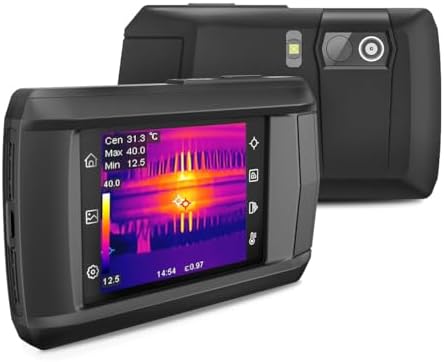
A thermal camera turns invisible heat into a picture, so a missing chunk of insulation, an overloaded breaker, or a hidden water leak stops being a guess and becomes something you can see. But the specs on the box are written to impress, and the biggest number listed is often the least honest one. We analyzed thousands of verified buyer reviews, recent sales data, and expert evaluations to find eight thermal cameras that show you what is really there.
Every product we compared, in ranked order. Tap through to Amazon to check today's price, or jump to the full review below.
1
P1
Best Overall
Thermal Master P1 Phone Thermal Camera
5.0
160 x 120 IR sensor · Plugs into phone · Under 20 grams
The most portable option here, a USB-C and Lightning dongle that turns an iPhone or Android phone into a thermal camera, with no battery to charge and one of the lowest prices in this lineup.
512 x 384 IR sensor · IP54, 2m drop-tested · 10.5-hour battery
A standalone handheld thermal camera with a 512x384 enhanced image, a full day's battery life, and rugged IP54 construction that testers describe as feeling like a genuine professional tool.
256 x 192 IR sensor · 640 x 480 enhanced display · Fusion overlay modes
A standalone HSFTOOLS camera pairing a 256x192 sensor with a 2MP visual camera for fusion overlays, the widest feature set and the largest onboard storage in this comparison.
96 x 96 IR sensor · 240 x 240 enhanced display · 3.5-inch touchscreen
A standalone handheld thermal camera from HSFTOOLS with a built-in visual camera and touchscreen, pairing AI scene detection with a compact, all-in-one body that doesn't need to be plugged into a phone.
TOPDON TC004 3.5-Inch Thermal Imaging Camera (64GB)
4.7
256 x 192 IR sensor · 3.5-inch touchscreen · 64GB onboard storage
Our pick for home inspection: TOPDON's full-size standalone camera pairs a 512x384 enhanced image with a 3.5-inch touchscreen, WiFi reporting and 64GB of onboard storage, built for documenting a full day of inspection work.
Thermal Master Thor002 Thermal Camera (Second Listing)
4.7
512 x 384 X3 IR · 5 imaging modes · 10.5-hour battery
A second listing of Thermal Master's Thor 002 platform: a 512x384 enhanced image, five imaging modes, a 10.5-hour battery and PC analysis with video recording, at a lower price than the other Thor 002 listing.
96 x 96 IR sensor · 240 x 240 enhanced display · 50° field of view
Our Best Value pick: the newest and most affordable standalone camera in this comparison, pairing a 96x96 sensor enhanced to a 240x240 display image with home-inspection basics like a wide 50-degree field of view and an automatic high/low temperature alarm.
128 x 128 IR sensor · Up to 15-hour battery · IP54, 2m drop-tested
A genuinely standalone handheld thermal camera with rugged 2-meter drop and IP54 ratings and up to 15 hours of battery life, the longest runtime in this comparison.
Short on time? These three cover most buyers: our Best Overall pick, a rugged standalone handheld camera with a full day's battery life, the best value standalone camera for occasional diagnostics, and the top choice for home inspection work with onboard storage and PC reporting.
Understand the category before you buy - what the science actually says, and which specs matter.
Every thermal camera advertises a resolution, a temperature range, and a refresh rate, but those numbers do not all carry the same weight, and one of them is quietly inflated on most spec sheets. Here is how these cameras work, the single number that tells you whether an image will be crisp or blurry, and the features actually worth comparing.
What does a thermal camera actually do?
A thermal camera reads the infrared energy every object gives off and translates it into a color image, where warmer areas look bright and cooler areas look dark. Nothing needs to be touched, and it works in complete darkness because it senses heat, not light. That lets you:
Spot heat loss around windows, doors, and missing insulation
Find overheating wires, breakers, and electrical connections before they fail
Trace radiant floor heating loops or a blockage in a pipe
Catch moisture and hidden leaks by the cool patch they leave behind
Every model here also shows a live temperature reading, so you see both the shape of the problem and how hot it actually is, across a range that reaches from -4 degrees F up to 1022 degrees F on cameras like the Thermal Master Thor and the TOPDON TC002C.
The resolution number on the box is not the one that matters
This is the thing most shoppers never learn. A thermal camera has two resolution figures, and brands lead with the larger one because it sells better. That larger figure, listed here as the enhanced or super resolution, is created in software: the camera takes the real image and upscales it, filling in extra pixels by guessing from the ones it already has. It does not add any new detail. It just stretches the same data across a bigger grid.
The number that actually matters is the native sensor resolution, the true count of infrared detector pixels behind the lens. Look at how far apart these two figures sit. The TOPDON TC002C advertises 512 x 384 but its real sensor is 256 x 192. The Thermal Master P1 shows 320 x 240 on the box while its detector is 160 x 120. The HP96 and HF96 list 240 x 240 super resolution over a native 96 x 96 sensor, which is a small detector doing a lot of stretching. At the top, the Thermal Master Thor carries a genuine 512 x 384 sensor, and the TOPDON TC002C and F2VW both sit at a real 256 x 192. More native pixels mean you can stand back from an electrical panel and still tell which single terminal is running hot, instead of seeing one warm blur.
Which specs actually matter?
Once you know to read the native number, a few features decide which camera fits your work:
Native sensor resolution: The real detector count, not the upscaled figure. This lineup runs from 96 x 96 up to a true 512 x 384. Higher means sharper detail and the freedom to inspect from a safer distance.
Refresh rate: How many times per second the image updates, measured in Hz. Every camera here refreshes at 25 Hz, which stays smooth as you pan across a wall or scan a moving motor. Bargain cameras sold at 9 Hz lag and smear on anything that moves, so 25 Hz is the number to protect.
Thermal sensitivity: Sometimes called NETD, this is the smallest temperature difference the camera can tell apart, and it is what reveals a faint stud line or damp spot behind a wall. The Thermal Master Thor states a 40 mK sensitivity, meaning it separates differences as small as four hundredths of a degree.
Temperature range: How hot and cold it can read. Most here span -4 degrees F to 1022 degrees F, which covers home, HVAC, and electrical work, while a couple stop lower at 662 or 752 degrees F.
Phone-attach or standalone: The TOPDON TC002C and the Thermal Master P1 plug into a USB-C phone and borrow its screen and battery, which keeps them pocket-sized and cheap. Standalone units like the Thor, HP96, and TOPDON TC004 have their own screen and battery, so nothing depends on your phone being charged.
Accuracy: How close the reading is to the true temperature. These cameras land around plus or minus 2 degrees C, or 2 percent of the reading, which is the normal band for this class.
Screen and extras: A laser pointer, a built-in visual camera for overlaying detail, and multiple color palettes all help you pinpoint and document a find. The Thor pairs a 3.5-inch IPS touchscreen with a 2MP visual camera and a laser.
How we grade products
Graded Picks rankings are aggregated from several independent signals: verified buyer ratings and the size of the review base for credibility, recent monthly purchase volume for relevance, assessments from trusted home, HVAC, and electrical publications, and how each product places in leading category lineups. For thermal cameras we weigh:
Native sensor resolution and real image clarity
Refresh rate and how smoothly it tracks movement
Thermal sensitivity for spotting subtle differences
Temperature range against the intended job
Phone-attach convenience versus standalone independence
Screen, palettes, and documentation features
Battery life and overall value for the price
Safety note: A thermal camera reads surface heat from a distance, so treat it as a way to find hazards, not a reason to get close to them. When it flags an overheating breaker or wire, keep your distance and bring in a licensed electrician rather than opening a live panel yourself. On the other end of the range, remember the camera measures surface temperature only, so it cannot see the state of anything sealed behind a thick or reflective surface.
In-Depth Reviews
Everything we learned from buyer reviews and expert testing, product by product.
P1
Best Overall
1. Thermal Master P1 Phone Thermal Camera
5.0
At roughly the size of a USB stick and about 18 grams, the P1 is the most pocketable camera in this comparison, plugging directly into a phone's USB-C or Lightning port and drawing power from the device rather than carrying its own battery. Reviewers, including a mainstream tech outlet, praised the plug-and-play setup and the companion app's dozen color palettes and isotherm mode, and measured temperature accuracy within about 2 degrees C of true readings in normal conditions. Its 160x120 VOx sensor is enhanced to a 320x240 Super IR image, enough for basic diagnostics but a clear step below the higher-resolution sensors in the Thor 002 or F2VW. The fixed-focus lens is the most-cited limitation: there's no manual or autofocus, so close-up or macro thermal work isn't its strength. What makes it easy to recommend is how little stands between opening the box and getting a usable thermal reading: no battery to charge, no separate screen to learn, and one of the lowest prices of any camera in this comparison, which makes it an easy choice for a wide range of buyers.
Thermal (IR) sensor resolution160 x 120
Enhanced/display resolution320 x 240 (Super IR)
Temperature range-4°F to 1112°F
Accuracy±2°C
Frame rate25 Hz
Display & controlsPlugs into phone (USB-C/Lightning), 12 color palettes, isotherm mode
Battery lifePowered via phone (no internal battery)
Pros
Extremely compact and lightweight - about the size of a USB stick
Plug-and-play with no battery to charge
Wide -4°F to 1112°F range for its price point
Companion app offers 12 color palettes and isotherm mode
One of the most affordable thermal cameras in this comparison
Cons
Fixed-focus lens with no manual or autofocus
Lower sensor resolution than the pricier models here
iOS support limited to USB-C iPhone models
Who is it for?
Buyers who want an ultra-portable, budget thermal camera that lives in a pocket or glovebox and uses their existing phone.
Who is it not for?
Anyone doing close-up electronics work or wanting the sharpest possible image - the Thor 002 resolves far more detail.
A premium standalone alternative to our Best Overall pick. The Thor 002 delivers what reviewers describe as almost everything that made its pricier predecessor great at roughly half the cost. Its X3 IR processing turns a 256x192 sensor into a 512x384 image on a 3.5-inch IPS screen that can blend thermal and visual images in fusion mode so you can see exactly which object a hotspot corresponds to. Testers measured a -4 degrees F to 1022 degrees F range with about 2 degrees C or 2 percent accuracy, backed by a 5,000 mAh battery rated for roughly 10.5 hours with 18W fast charging, and confirmed it survives a 2-meter drop test with IP54 dust and splash protection, genuinely rugged for a device in this price range. That combination of image quality, battery life and durability earns it our Best Overall pick and makes it the strongest standalone choice here for long field days and rough job sites, though it costs more than the F2VW below. The one consistently noted limitation is its fixed-focus lens: unlike its Thor 001 predecessor, it has no macro option, so it is built for room-scale diagnostics rather than close-up electronics work.
Thermal (IR) sensor resolution512 x 384
Enhanced/display resolution640 x 480 (3.5-inch IPS)
Temperature range-4°F to 1022°F
Accuracy±2°C or ±2% of reading
Frame rate25 Hz
Display & controls3.5-inch IPS touchscreen, laser pointer, 2MP visual camera
Battery lifeUp to 10.5 hours (5,000 mAh, 18W fast charging)
Pros
Sharp 512x384 enhanced image on a 3.5-inch IPS screen
IP54-rated and 2-meter drop-tested construction
Roughly 10.5 hours of battery life with 18W fast charging
Fusion mode blends thermal and visual images for clear documentation
The F2VW pairs a 256x192 IR sensor, enhanced via super-resolution processing to a 640x480 image on its 3.2-inch screen, with a 2MP visual camera that layers Visual, Thermal, Fusion and picture-in-picture modes onto the same view, useful for documenting exactly what a hotspot corresponds to on a wall or panel. It ships with 16 GB of onboard storage and a carrying case, the most complete field-ready package in this comparison, and its roughly 6-hour battery life comfortably covers a full inspection. Sensitivity is rated below 40 mK at 25 Hz, over a -4°F to 1022°F range. It is not the longest-running or the toughest camera here: the Thor 002 offers a bigger battery and an IP54 body, but the F2VW's combination of visual-camera fusion, a wide temperature range and a complete accessory kit makes it one of the best all-around standalone choices in this lineup.
The HP96 is HSFTOOLS' entry-level standalone thermal camera, built around a 96x96 sensor that its Live Super Resolution algorithm enhances to a 240x240 display image, viewed on a 3.5-inch touchscreen rather than a phone screen. Reviewers highlight the built-in visual camera for overlaying reference images onto thermal readings, AI-assisted scene detection for common inspection targets, and a rugged build that survives a 2-meter drop test with IP54 dust and splash resistance. It covers a -4°F to 662°F range at 25 Hz, comfortably enough for home electrical panels, HVAC ducts and insulation checks. The trade-off against its HSFTOOLS siblings is resolution: the base 96x96 sensor is the lowest in the HSFTOOLS lineup here, so fine-detail diagnostics benefit from stepping up to the F2VW or HF96.
Thermal (IR) sensor resolution96 x 96
Enhanced/display resolution240 x 240
Temperature range-4°F to 662°F
Accuracy±2%
Frame rate25 Hz
Display & controls3.5-inch touchscreen, built-in visual camera, AI scene detection
Battery lifeUp to 4 hours (rechargeable Li-ion)
Pros
Standalone body with its own touchscreen - no phone required
Built-in visual camera for reference overlays
IP54-rated and 2-meter drop-tested construction
AI-assisted scene detection for common inspection targets
Wide -4°F to 662°F range for home and light-duty use
Cons
Lowest native sensor resolution among the HSFTOOLS models here
Shorter battery life than its HSFTOOLS siblings
Limited coverage from mainstream tech publications so far
Who is it for?
Buyers who want a fully standalone thermal camera with its own screen and don't need the sharpest possible image.
Who is it not for?
Anyone who wants finer thermal detail - the F2VW and HF96 both step up the sensor resolution.
5. TOPDON TC004 3.5-Inch Thermal Imaging Camera (64GB)
4.7
The TC004 is our pick for home inspection work and TOPDON's inspection-focused standalone camera, built around a 256x192 native sensor that TISR processing enhances to a 512x384 display image on a 3.5-inch touchscreen. Reviewers at Gough's Tech Zone and The Gadgeteer highlighted its rugged IP54 and 2-meter drop-tested housing, a built-in laser pointer and LED light for pinpointing and illuminating a target, and 64GB of onboard storage that holds a full day of inspection images and video without a memory card. WiFi connects to TOPDON's TopInfrared mobile app for quick review, while a USB connection and the TopView PC software support the file transfer and analysis workflow that Pro Tools Guide and Nucleusky both singled out as a strength for technicians who need to write up findings afterward. It covers a -4°F to 1022°F range at 25 Hz with sub-40mK thermal sensitivity, and about 8 hours of battery life on a charge.
6. Thermal Master Thor002 Thermal Camera (Second Listing)
4.7
This listing carries the Thor 002 specification: a 256x192 sensor enhanced by X3 IR processing to 512x384 on a 3.5-inch IPS screen, 40 mK sensitivity, a -4°F to 1022°F range, and a 5,000 mAh battery rated for about 10.5 hours. Reviewers of the Thor 002 praise its five shooting modes (IR, Pro-Mix, IR-Fuse, picture-in-picture and Visible), the fusion view that shows exactly which object a hotspot belongs to, and a solid IP54 body drop-tested to 2 meters. This version also highlights video recording and PC analysis, which suits electrical inspectors who write up their findings. It looks like the same camera sold under a separate listing from our other Thor 002 entry, so check which listing is cheaper and what is in the box before choosing, since the two do not differ meaningfully on paper. Like the rest of the family it has a fixed-focus lens with no macro mode, so it is built for room-scale diagnostics rather than close-up board work.
Our Best Value pick. The Flagfront YXI96 enters this lineup as a budget-focused standalone camera that follows the same 96x96-sensor-to-240x240-display formula as the HSFTOOLS HP96 and HF96, at a lower price than either. A head-to-head comparison from Thermal Test Lab found it evenly matched with the HF96 for buyers who need visible heat clues rather than lab-grade detail, describing it as the more budget-friendly entry point of the two while noting the HF96's AI scene detection gives it an edge for documentation-heavy inspection work. Independent testers who ran it on roof leaks and garage insulation checks on YouTube reported that the 240x240 super-resolution output looked sharper than expected at this price, with the 25 Hz refresh rate staying smooth while panning across a wall or panel. It reads a -4°F to 1022°F range with about 2% accuracy, a 50-degree field of view wide enough for whole-room scans, and pairs a built-in high/low temperature alarm with a drop-tested, IP54-rated body rated to survive a fall from around 6.6 feet. As the newest listing in this category, it has the shortest track record of any camera here, and its feature set stops at the basics: no laser pointer, no visual-camera overlay and no fusion imaging modes.
Thermal (IR) sensor resolution96 x 96
Enhanced/display resolution240 x 240 (TISR)
Temperature range-4°F to 1022°F
Accuracy±2%
Frame rate25 Hz
Display & controls50° FOV, high/low temp alarm, large display
Battery lifeUp to 9 hours (rechargeable Li-ion), IP54-rated
Pros
Same 96x96-to-240x240 super-resolution imaging as the pricier HSFTOOLS models, at a lower price
Wide 50-degree field of view suits quick, whole-room scans
IP54-rated, drop-tested body rated to survive falls from around 6.6 feet
Automatic high/low temperature alarm flags problem areas without manual hunting
25 Hz refresh rate stays smooth panning across a wall or panel
Cons
No laser pointer, visual-camera overlay or fusion imaging modes
Newest listing in this category, with the shortest independent track record here
Base 96x96 native sensor is the same modest resolution as the entry-level HP96, not a step up
Who is it for?
Extremely budget-focused buyers who want the same super-resolution imaging approach as the HSFTOOLS models at the lowest price in this comparison.
Who is it not for?
Anyone who wants a laser pointer, visual-camera overlay or fusion imaging modes - the F2VW and HF96 above add those.
The TC004 Mini packs real durability and the longest battery life of any standalone camera in this comparison. Its 128x128 sensor is enhanced via TISR technology to a 240x240 display image, and testers found the sensitivity strong enough to catch trace heat signatures for electrical, automotive and HVAC diagnostics despite the modest native resolution. A 2,900 mAh battery rated for up to 15 hours of runtime, automatic shutoff timers and an ergonomic one-handed grip round out a design reviewers call an easy yes for occasional diagnostic use. The honest limitations: there's no video recording or wireless connectivity, and the lower native sensor resolution means images can look slightly over-processed compared to the higher-resolution Thor 002 - it's built for occasional diagnostic use rather than professional-grade documentation.
Thermal (IR) sensor resolution128 x 128
Enhanced/display resolution240 x 240 (TISR)
Temperature range-4°F to 842°F
Accuracy±2°C
Frame rate25 Hz
Display & controls2.4-inch screen, high/low temp alerts, auto shutdown
Battery lifeUp to 15 hours (2,900 mAh)
Pros
Longest battery life in this comparison at up to 15 hours
IP54-rated and rated for 2-meter drops
One of the most affordable standalone (non-phone) cameras here
Ergonomic one-handed design with intuitive controls
High/low temperature alerts and automatic shutoff
Cons
No video recording capability
No wireless connectivity for remote monitoring or sharing
Lower native sensor resolution than the Thor 002 or TOPDON's own TC002C Duo
Who is it for?
Budget-conscious buyers who want a genuinely standalone, durable camera for occasional home diagnostics.
Who is it not for?
Frequent professional users who need video capture or the sharpest possible image.
The stars you see are the Graded Picks cumulative score, not a single retailer's average. It blends verified buyer reviews aggregated across major retailers, assessments from professional reviewers and expert testers, and how prominently the product features in leading category lineups.
Advertising Disclosure
Our rankings are compiled by aggregating several independent signals, including verified buyer feedback, how popular a product currently is with shoppers, and evaluations published by professional reviewers. Editorial opinions are our own.
Please note that we participate in affiliate marketing programs. When you purchase through links on our site, we may earn a commission. As an Amazon Associate we earn from qualifying purchases. This comes at no additional cost to you and helps support the resources required to provide valuable content.