An ultra short throw projector sits just inches from the wall and throws a picture the size of a small billboard, no ceiling mount and no cable run across the room. But the brightness numbers on the box are where marketing gets loud, and a room full of daylight can wash out a projector that looked incredible in the store. We analyzed thousands of verified buyer reviews, recent sales data, and expert evaluations to find eight ultra short throw projectors, and the screens that make them look their best.
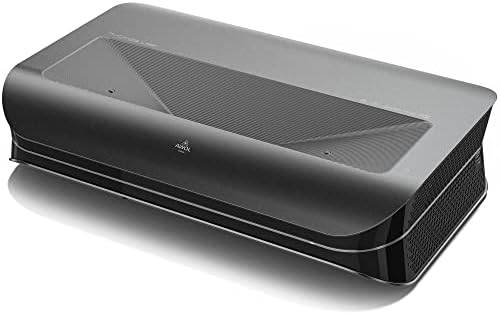
Our Best Overall pick: a genuine 4K triple-laser ultra short throw projector with Dolby Vision, Dolby Atmos and low-lag gaming support that reviewers rank among the brightest and most color-accurate UST projectors available.
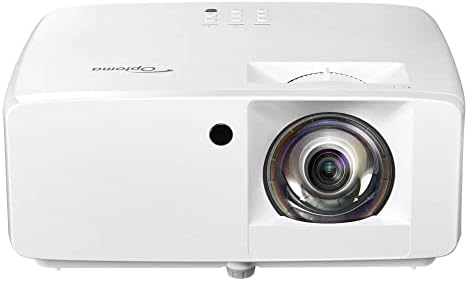
Our Best Value pick among true ultra short throw projectors: the more affordable sibling to the GT3500HDR, trading some brightness and a slightly larger footprint for a lower price while keeping the same DuraCore laser reliability and low-lag gaming mode.
Not a projector - a motorized ambient-light-rejecting screen built specifically to pair with UST projectors, rising from a floor unit at the push of a button and retracting flush to the floor when not in use.
Optoma GT3500HDR Ultra Short Throw Laser Projector
4.7
Ultra short throw · 1080p · 3,800 ANSI lumens
Our pick for small rooms: a genuinely compact ultra short throw laser projector that can fill a 100-inch image from under 2 feet away, with ultra-low input lag that multiple outlets single out as best-in-class for gaming.
A battery-powered, sub-4-pound ultra short throw projector that packs a triple RGB laser and Google TV into a chassis small enough to travel with, throwing a 100-inch image from under a foot away.
A lightweight, standard-throw portable projector, not an ultra short throw model, with AI auto-focus, obstacle avoidance and a built-in smart TV OS that packs in Netflix and Prime Video apps.
A compact, Google TV-powered laser projector that a wide swath of home-theater press rates among the best portable laser projectors available, even though it needs several feet of throw distance rather than sitting flush against the wall.
Short throw (5 ft fixed) · 1080p · 3,000 ANSI lumens
A short throw, not ultra short throw, gaming and home theater projector with elite gaming performance, deep review coverage and strong value, at a genuinely affordable price.
Short on time? These three cover most buyers: our Best Overall true ultra short throw projector, the top pick for small rooms, and the best value among true UST projectors.
Ultra Short Throw Projectors 101: What They Do & How to Choose
Understand the category before you buy - what the science actually says, and which specs matter.
Every UST projector promises a huge, sharp, cinema-bright image from a cabinet that tucks under your TV shelf, but the specs that decide whether you actually get that picture are not always the ones printed largest. Here is how these projectors work, why one brightness number is honest and another is not, and the features worth comparing before you buy.
What does an ultra short throw projector actually do?
A UST projector uses a wide-angle lens and a mirror to fire its image steeply upward onto the wall from very close range. Where a traditional projector needs to sit across the room, a UST fills a big screen from just inches away.
It projects from a very short distance. The Hisense PL2 covers an 80 to 150 inch image from as little as 7 to 18 inches off the wall, and the Optoma GT2000HDR throws a 100 inch picture from just over 4 feet.
It uses a laser or LED light source rather than a lamp, so most models here last 20,000 to 50,000 hours with no bulb to replace.
It usually runs a smart TV platform built in, such as the Google TV interface built into the Dangbei Atom, so streaming apps live on the projector itself.
The brightness number that actually tells the truth
This is the part worth understanding before you trust any spec sheet. Projector brightness gets quoted in two very different ways, and only one of them lets you compare models fairly.
Some listings advertise inflated "light-source" or "LED" lumens, a figure measured at the light engine before the image ever reaches the wall. ANSI lumens is the honest, standardized measure of how bright the actual picture is, averaged across the screen. When you compare across this lineup, stick to the ANSI figure. The Optoma GT2000HDR delivers 3,500 ANSI lumens and the Hisense PL2 delivers 2,700, while the ONOAYO ONO3 Pro is rated at 1,500 ANSI lumens and the Optoma Photon Go at just 650. Those are large, real gaps, and they hold up because every one is stated in the same ANSI unit.
Here is the twist most shoppers miss: because a UST sits inches from the wall, the screen you pair it with does more for a bright-room picture than chasing extra lumens ever will. An ambient-light-rejecting, or ALR, screen is engineered to soak up the overhead and side light that flattens a projected image, while still reflecting the projector's own light back at you. That is why this lineup includes a UST-specific ALR screen: the AWOL Vision motorized floor-rising screen rejects 95% of ambient light at 0.8 gain while still accepting a UST projector's own steep-angle light. In a room with windows, that screen matters as much as the projector.
Which specs actually matter?
Once you know how to read brightness, a handful of features decide which setup fits your room:
ANSI lumens: The honest brightness measure. This lineup spans 650 to 3,500 ANSI lumens. Go bright, toward the 3,000 to 3,500 range, for rooms with daylight; a dim, dedicated theater can live comfortably lower.
Resolution: This lineup currently leans 1080p: models like the Optoma GT2000HDR and BenQ TH671ST are native 1080p that accept or decode a 4K signal for tone-mapped detail, which still looks excellent at normal seating distances.
Throw ratio and max image size: A true UST throw ratio fills a big screen from inches away. Max sizes here run up to 150 inches on the AWOL Vision LTV-2500 and Hisense PL2, with others landing near 100 inches.
Light source and lifespan: Laser and triple-laser models rate 20,000 to 30,000 hours, and the LED portable in this group is rated up to 50,000 hours, so the light engine outlives most TVs.
Contrast and HDR: Contrast decides how deep the blacks look. The Optoma GT2000HDR is rated at 300,000:1 dynamic contrast with 4K HDR input support, which helps a projected image feel like a real screen.
The screen: For any bright room, pair the projector with a UST ALR screen. Rejection ratings here reach 95%, and that does more for daytime viewing than a few hundred extra lumens.
How we grade products
Graded Picks rankings are aggregated from several independent signals: verified buyer ratings and the size of the review base for credibility, recent monthly purchase volume for relevance, assessments from trusted home theater publications, and how each product places in leading category lineups. For ultra short throw projectors we weigh:
Real ANSI brightness and how it holds up in ambient light
Resolution and image sharpness
Contrast, color, and HDR performance
Throw flexibility and maximum image size
Light source lifespan and reliability
Smart platform and connectivity
Pairing with a suitable ALR screen, and overall value
Setup note: A UST projector is only as sharp as its alignment. Because it fires so steeply from such a short distance, a shift of even a fraction of an inch can throw the corners out of focus or geometry, so set the projector on a stable surface, level it carefully, and expect to fine-tune its position against your screen. Pairing it with a UST-specific ALR screen, rather than a plain white wall or a standard projector screen, is what unlocks the bright, high-contrast picture these are built to deliver.
In-Depth Reviews
Everything we learned from buyer reviews and expert testing, product by product.
The LTV-2500 earns Best Overall as the standout true ultra short throw projector in this comparison, sitting as little as 6 inches from the wall to fill an 80-150 inch screen. Multiple independent home-theater outlets tested it and consistently found it surpasses nearly every other UST projector in brightness, rated at 2,125 ANSI lumens with a 2,600-lumen peak from its triple-laser light source, while delivering better black-level performance and HDR handling than most competitors in its price class. A Ricoh-engineered ultra-short-throw lens keeps the image sharp edge to edge, Dolby Vision and Dolby Atmos support add real home-theater polish, and gaming input lag of 15ms at 4K/60Hz (8ms at 1080p/120Hz) makes it genuinely usable for console and PC gaming rather than just movies. Reviewers describe it as a sweet spot of performance and value in the premium UST tier, with a 25,000-hour laser light source and 36W built-in speakers with Dolby Atmos/DTS Virtual:X reducing the need for a separate sound system.
Projector type / throw distanceUltra short throw (0.5-1.68 ft for 80-150in image)
The GT2000HDR earns our Best Value pick as the most affordable genuine ultra short throw projector built for full home-theater use in this comparison. It shares its DuraCore laser platform and ultra-compact UST design with Optoma's higher-end GT3500HDR, filling a 120-inch image from about 4 feet 4 inches away and a 100-inch image from just over 4 feet - genuinely UST placement for a compact laser projector. One long-term reviewer who used it for over a year describes it as an outstanding projector that stays bright and clear even with some ambient light, is easy to set up, and runs a low-lag gaming mode alongside dual HDMI inputs and a built-in 15-watt speaker. Its 3,500 ANSI lumen DuraCore laser source is rated for 30,000 maintenance-free hours and adds IPX6 dust resistance, a durability touch not every competitor offers. The most consistent criticism across reviews is a subpar built-in speaker that most buyers pair with an external soundbar, plus the lack of an optical zoom lens, which means image size is fixed by placement distance rather than adjustable from one spot.
Projector type / throw distanceUltra short throw (~1m for 214in image; ~4ft4in for 120in)
ResolutionFull HD 1080p (4K HDR input support)
Brightness3,500 ANSI lumens (DuraCore laser)
Light source life30,000 hours
Max image size300 inches advertised (best well under that in practice)
Connectivity2x HDMI, RCA, USB
Warranty1 year parts/labor + 5-year/12,000-hour laser source
Pros
Genuine UST placement with DuraCore laser reliability at the lowest price of any true UST projector here
IPX6 dust resistance adds durability most competitors skip
Long-term reviewer reports it stays bright and clear even with some ambient light
Low-lag gaming mode and dual HDMI inputs cover console and PC use
Cons
Built-in 15-watt speaker is a consistently reported weak point
No optical zoom - image size is fixed by placement distance
Native 1080p resolution, not the true 4K panel found on the AWOL and Hisense models here
Who is it for?
Buyers who want genuine UST laser performance and Optoma's durability touches at the lowest price among true UST projectors in this comparison.
Who is it not for?
Anyone who wants to adjust image size from a fixed placement spot without moving the projector - there's no zoom lens here.
This AWOL Vision screen is a companion accessory for ultra short throw projectors rather than a projector itself, and it's built to solve the specific problem UST owners face: watching in a room that isn't fully dark. The motorized floor-rising design stores flat inside its base and rises to a full 120-inch viewing surface with one control input, with a self-tensioning mechanism that keeps the surface wrinkle-free at any point in the cycle. Its ALR (ambient light rejecting) coating is rated to reject about 95% of ambient light hitting it from above while still accepting the steep-angle light from a UST projector below, and a 170-degree viewing angle keeps color and contrast consistent from off-center seats. Reviewers who've paired it with UST projectors report a genuinely improved image in rooms with windows or ceiling lights compared to a standard matte screen or a bare wall, and the automatic rise/retract mechanism means it disappears completely when not in use rather than occupying wall space permanently.
4. Optoma GT3500HDR Ultra Short Throw Laser Projector
4.7
Our pick for small rooms. The GT3500HDR is a true ultra short throw model built around Optoma's DuraCore laser engine, throwing a 90-130 inch image from as little as 8 inches off the wall - the smallest footprint of any projector in this comparison. Coverage from Forbes, New Atlas and dedicated projector-review outlets highlights its 3,800 ANSI lumen brightness (among the brightest 1080p UST projectors available) and gaming-focused input lag as low as 8.6ms at 1080p/120Hz and 17ms at 4K/60Hz input, roughly four times lower than typical competing display tech. Its Full HD 1080p native panel accepts 4K HDR input for tone-mapped detail even though it doesn't display native 4K resolution, and the eco-friendly, roughly 28%-smaller-than-predecessor chassis is built with up to 50% recycled plastics. Optoma backs the DuraCore laser source for up to 30,000 hours, with a notably long 5-year (or 12,000-hour) light-source warranty layered on top of the standard 1-year parts and labor coverage - reassurance for a category where light-source longevity is a real cost consideration.
Projector type / throw distanceUltra short throw (0.66-1.31 ft for 90-130in image)
ResolutionFull HD 1080p (4K HDR input support)
Brightness3,800 ANSI lumens (DuraCore laser)
Light source life30,000 hours
Max image size130 inches
Connectivity2x HDMI, RCA, USB
Warranty1 year parts/labor + 5-year/12,000-hour laser source
Pros
Smallest footprint of any projector here - fills 100in from under 2 feet away
3,800 ANSI lumens is bright even among ultra short throw competitors
Best-in-class gaming input lag (8.6ms at 1080p/120Hz)
5-year/12,000-hour laser light-source warranty is unusually generous
Cons
Native panel is 1080p, not true 4K, despite accepting 4K HDR input
This exact listing is new enough that broad buyer feedback is still limited
Standard parts/labor warranty is only 1 year (the laser source is covered longer)
Who is it for?
Small and medium rooms where a compact, genuinely wall-flush UST footprint and low-lag gaming both matter.
Who is it not for?
Buyers who specifically need native 4K resolution rather than a bright, sharp 1080p image.
The Photon Go is Optoma's take on a truly portable ultra short throw projector, pairing a triple RGB laser engine with a built-in battery and Google TV in a chassis reviewers describe as small enough for a carry-on bag. Its throw ratio is one of the tightest in this comparison, filling a 100-inch image from just under a foot off the wall and a 60-inch image from a few inches away - a genuine fit for small or tight rooms - and a front-facing time-of-flight sensor handles auto-focus and auto-keystone so it can be set up on nearly any flat surface in seconds. Reviewers praise the color richness its RGB laser brings to Google TV's built-in Netflix and Disney+ apps, but they're also consistent that its 650 ANSI lumen rating limits it to dark or dim rooms, that the battery lasts roughly an hour to 90 minutes depending on brightness mode, and that fan noise is noticeable even at moderate volume. It's best understood as a genuinely novel travel and casual-use projector rather than a primary home theater display.
Projector type / throw distanceUltra short throw (0.34-0.81 ft for 60-100in image)
ResolutionFull HD 1080p (native, DLP triple laser)
Brightness650 ANSI lumens (triple RGB laser)
Light source life20,000 hours
Max image size100 inches
ConnectivityHDMI, built-in Wi-Fi & Bluetooth, Google TV
Warranty1 year limited parts and labor
Pros
Genuinely portable: battery-powered, TSA-compliant, and small enough for a carry-on
Triple RGB laser delivers richer color than most projectors this size
Auto-focus and auto-keystone via a time-of-flight sensor simplify setup on any surface
Google TV built in, with Netflix and Disney+ certified apps, needs no separate streaming stick
Cons
650 ANSI lumens is dim - usable brightness really requires a dark or dimmed room
Battery life runs roughly an hour in Bright mode, closer to 90 minutes in Eco
Auto-keystone correction and fan noise are recurring complaints in hands-on reviews
Who is it for?
Buyers with a small room or tight space who want a genuinely portable, battery-powered projector for bedrooms, dorms, backyards or travel rather than a fixed home-theater centerpiece.
Who is it not for?
Anyone who wants the brightest or sharpest possible UST picture - the Optoma GT2000HDR above delivers noticeably stronger image quality.
Despite appearing in an ultra-short-throw lineup, the ONO3 Pro is a conventional portable projector that needs 1.5 to 18 feet of throw distance depending on image size, not the inches-from-the-wall placement that defines a true UST model, worth knowing if compact placement is why you're shopping this category. What it does deliver is genuinely useful for casual and travel use: reviewers praise its AI-driven auto-focus, keystone correction and obstacle avoidance for locking in a sharp image within seconds of placement, a proprietary Smart TV Pro operating system with built-in Netflix, Prime Video and YouTube apps, and a body light enough to hold in one hand. Its native 1080p panel decodes 4K signals rather than displaying true 4K detail, and its 1,500 ANSI lumen rating is best suited to dim or dark rooms rather than daytime viewing. For a portable, plug-in secondary projector for bedrooms or casual movie nights, reviewers call it a strong value; for a dedicated home-theater centerpiece, it's outmatched by the true UST models in this comparison.
Projector type / throw distanceStandard/portable throw (1.5-18 ft for 50-300in image)
ResolutionNative 1080p (4K signal decoding)
Brightness1,500 ANSI lumens
Light source life50,000 hours (LED)
Max image size300 inches advertised (best under 120in in practice)
ConnectivityWi-Fi 6, Bluetooth 5.2, HDMI, USB
Warranty3 years (1-year returns, lifetime tech support)
Pros
AI auto-focus, keystone correction and obstacle avoidance work well in casual setups
Built-in Smart TV Pro OS includes Netflix, Prime Video and YouTube apps
Lightweight, portable body suits travel and casual room-to-room use
3-year manufacturer warranty is longer than most projectors in this comparison
Cons
Not actually an ultra short throw projector - needs feet of clearance, not inches
1,500 lumens is dim for anything but a dark or dim room
Native 1080p panel only decodes, rather than truly displays, 4K detail
Who is it for?
Casual and travel use, secondary bedrooms, or dark-room movie nights where portability matters more than UST placement.
Who is it not for?
Anyone shopping this category specifically for a projector that sits flush against the wall - this is a standard-throw portable model instead.
The Dangbei Atom stands out on the strength of some of the broadest, most consistently positive professional coverage in this comparison - outlets including RTINGS, Tom's Guide, TechRadar, ProjectorReviews and AppleInsider have all tested it, and independent measurements have found actual brightness as high as 1,331 lumens against its 1,200 ANSI lumen rating. Its ALPD laser engine, auto-focus and built-in Google TV platform, with certified Netflix and other major streaming apps, combine for an easy, plug-in setup that testers describe as bright and portable enough to move room to room. Worth flagging clearly: unlike the Optoma models elsewhere in this comparison, the Atom is a standard-throw projector rather than a true ultra short throw design, needing roughly 5 feet of clearance for a 60-inch image and up to 17 feet for its maximum 180-inch size, so it does not offer wall-flush UST placement. Reviewers are consistent that picture quality and built-in audio, while good for the size and price, trail the very best dedicated home-theater projectors, and at least one outlet found its overall value overshadowed by pricier rivals from LG and Samsung. For buyers who care more about a reviewer-favorite, easy-to-place laser projector than about hugging the wall, it remains a standout in this lineup.
Projector type / throw distanceStandard/portable throw (1.2:1 ratio; ~5-17 ft for 60-180in image)
The TH671ST stands out on the strength of review depth and all-around performance, even though it's a short throw projector rather than one of the wall-flush ultra short throw models elsewhere in this lineup, worth knowing up front if placement in a tight room is the deciding factor for your setup. What tips the scales is professional review depth and gaming performance: outlets including RTINGS, ProjectorCentral and Gaming Nexus tested it and consistently praised its ultra-low input lag (measured as low as 11ms, with BenQ rating it at 16.67ms), calling the gaming performance the best available in a projector at its roughly $949 price point. Its 3,000 ANSI lumen DLP lamp engine (not laser) delivers nicely saturated color and good contrast for dark home-theater scenes, and a 1.2x zoom lens adds placement flexibility that fixed-throw-ratio UST projectors don't offer. The main trade-offs versus the laser UST models here are a lamp-based light source with a shorter 10,000-hour rated life and no HDR support, but reviewers still call it an impressive value that exceeded expectations for both gaming and movies, and the combination of price, review depth and performance makes it a compelling choice even for buyers who ultimately want genuine wall-flush UST placement and choose one of the Optoma models above instead.
Projector type / throw distanceShort throw, not UST (fixed 5 ft for 60-100in image)
ResolutionFull HD 1080p (1920x1200 max signal)
Brightness3,000 ANSI lumens (DLP lamp, not laser)
Light source life10,000 hours (240W lamp)
Max image size300 inches advertised (realistic best ~100-120in)
ConnectivityHDMI, VGA, USB 2.0, IR
Warranty3 years
Pros
Some of the deepest, most positive professional review coverage in this comparison
Ultra-low input lag makes it a genuine standout for console and PC gaming
The stars you see are the Graded Picks cumulative score, not a single retailer's average. It blends verified buyer reviews aggregated across major retailers, assessments from professional reviewers and expert testers, and how prominently the product features in leading category lineups.
Advertising Disclosure
Our rankings are compiled by aggregating several independent signals, including verified buyer feedback, how popular a product currently is with shoppers, and evaluations published by professional reviewers. Editorial opinions are our own.
Please note that we participate in affiliate marketing programs. When you purchase through links on our site, we may earn a commission. As an Amazon Associate we earn from qualifying purchases. This comes at no additional cost to you and helps support the resources required to provide valuable content.